-1751978393.webp)
Updated November 2026 for the 2027 intakes.
Study abroad fraud has become more organised, and it targets the families who are most eager to help their children go abroad. Fake offer letters, made-up visa fees and 'guaranteed admission' packages now look polished enough to fool careful parents. The most useful tips for study abroad in 2027 have nothing to do with choosing a university. They are about checking every document, every payment and every promise before money leaves your account.
At a glance
Heading into the 2027 intakes, Indian families mostly face five kinds of study abroad scams: fake admission or acceptance letters, fake visa fees, forged financial documents, fake scholarship offers and rental deposit fraud. Each one relies on urgency and on parents not knowing what the official process looks like, so learning that process is your best protection.
The number of possible targets is huge. In a written reply to the Rajya Sabha, the Minister of State for External Affairs reported about 18.82 lakh Indian students studying in 153 countries (Free Press Journal, 2025). The same reply said Indian missions issue advisories against fraudulent or unaccredited courses. It named countries including Canada, Ireland, Malta, Finland and Latvia, which shows that no destination is completely safe.
Fraud is also showing up inside applications. A screening firm used by one third of UK universities found that around 4% of a sample of applications it screened for the September 2025 intake involved fraud. Forged documents made up the largest share (40%) of detected fraud (Russell Group, 2026). In some cases, families do not know that an agent has added a forged document to their file.
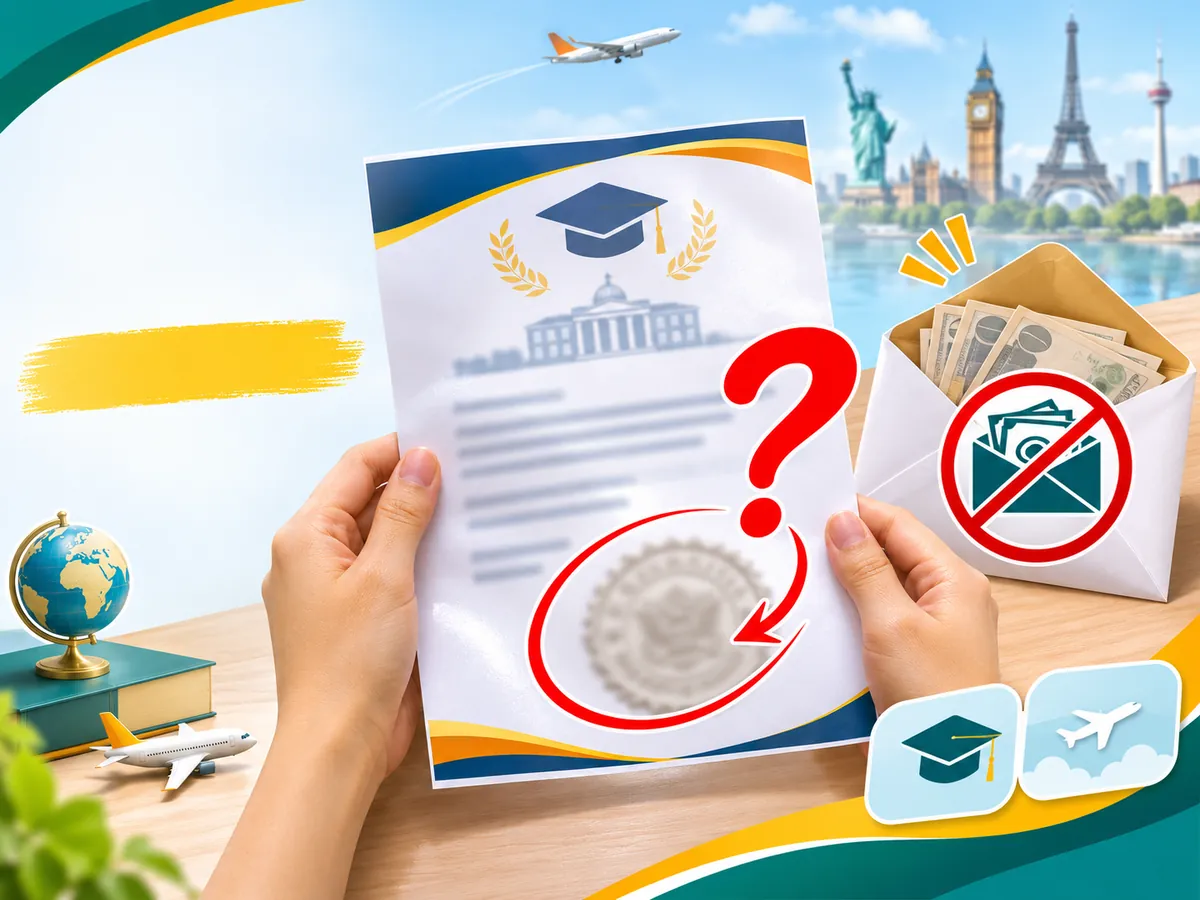
A fake offer letter scam usually begins when an agent promises admission to a well-known university, collects a large 'confirmation fee' and hands over a letter that looks official. The student only learns the truth when the visa is refused or, worse, after arriving in the country, when the university has no record of the student.
Canada is the best-known example. Several students faced enforcement action after fake acceptance letters were submitted with their earlier study permit applications (IRCC, 2023). In response, Canada's immigration department (IRCC) now asks every post-secondary college or university to confirm each overseas applicant's letter of acceptance directly with IRCC. That check has applied since 1 December 2023 (IRCC, 2024).
The same pattern shows up in other countries. Watch for these warning signs:
The fix is simple. Find the admissions email address on the university's official website and send the university your letter with your name and date of birth. Ask them to confirm that it is genuine. A real university will reply, and a real consultant will welcome the check.
To tell whether a study abroad consultant is genuine, check whether it has a permanent office you can visit, counsellors with verifiable training, written fee terms and published university partnerships. A genuine consultant will also explain the risks to you openly. A scammer sells certainty, while a genuine counsellor tells you what is likely and what is not.
Whether you are comparing study abroad consultants in Pune, Delhi or Nashik, ask these questions at the first meeting:
If a consultant gets defensive about any of these questions, walk away. The extra week you spend checking is far cheaper than a refused visa or a lost deposit.
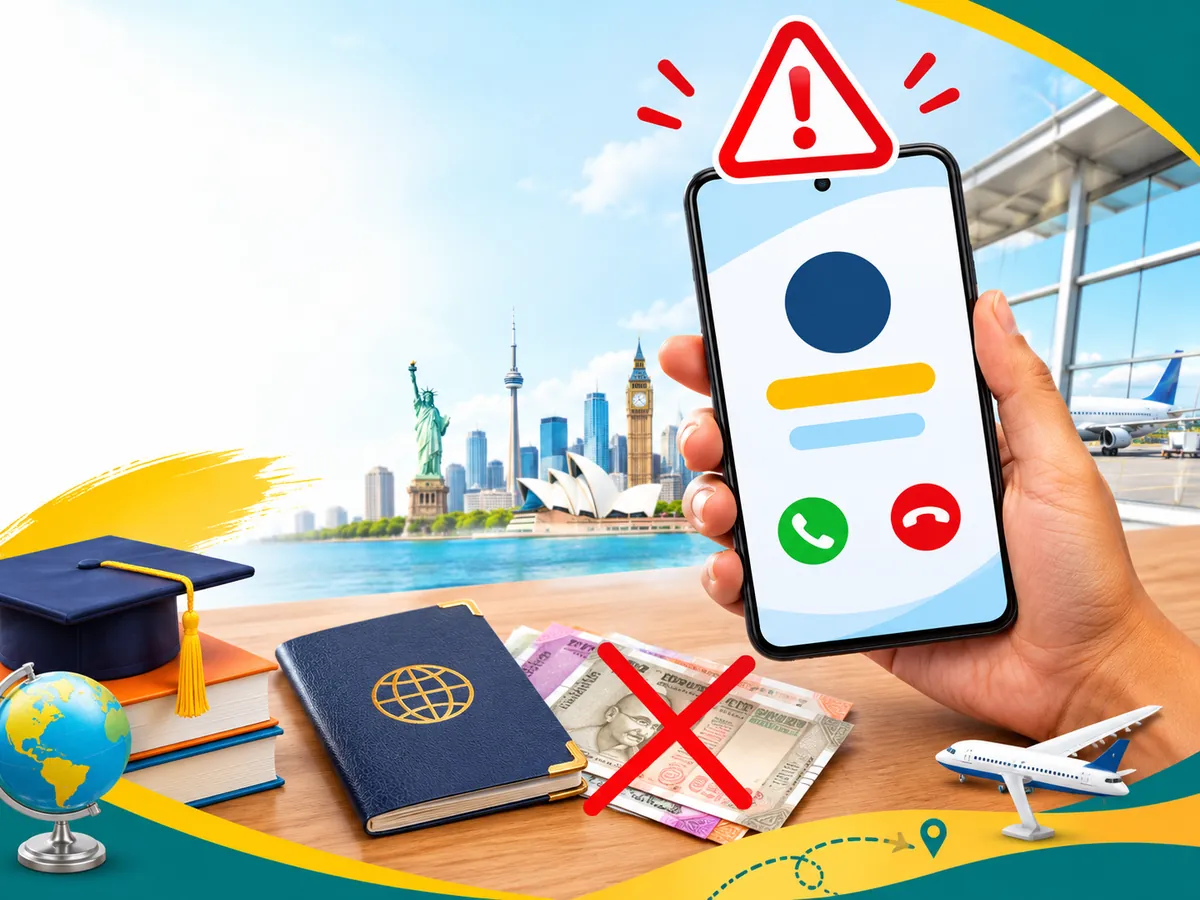
The most common visa scams are calls or emails that pretend to come from an embassy or visa centre. They demand urgent fines, verification fees or payment for faster appointments, usually by UPI, cash or transfer to a personal account. Real governments never collect visa money this way.
The UK government says plainly that you will never be asked to pay for a visa using cash or a money transfer (GOV.UK, 2026). In November 2026, the Home Office repeated that warning to applicants worldwide:
You'll never be asked to pay for a visa using cash or money transfer. (UK government guidance, Report visa and immigration scams, GOV.UK, 2026; also reported by TheGuildNG, 2026)
UK Visas and Immigration (UKVI) also listed four red flags: people who guarantee visas or jobs, appointment offers you cannot verify through official channels, unexpected contact asking for money or personal details, and pressure to act fast or keep things secret (Vanguard, 2026). The same reporting notes that applicants who submit forged documents face refusal and a 10-year ban on UK visa applications (TheGuildNG, 2026).
The 10-year ban matters a great deal for Indian families. Some agents try to strengthen a file by editing bank statements or test scores without telling the family. The student, not the agent, carries the ban. Always read every document before it is submitted in your name.
Scholarship, loan and accommodation offers are safe when they come from the university, a regulated bank or a known housing provider. They are risky when an outsider asks for an upfront processing fee to release money. Genuine scholarships do not charge you to receive them, and genuine landlords let you check the property before you pay.
Here is how these three scams usually look:
The same rule applies to cities and countries. These checks apply in every major study city, because rental fraud follows students wherever housing demand is high, from London to Sydney and Toronto.
The best way to stay safe is to verify before you pay, pay only official channels and keep every record. Families who follow this checklist from the first counselling session to the day of the flight are far harder to scam.
It also helps to start early. Families working toward a 2027 intake who begin 12 to 18 months ahead have time to verify each step instead of rushing.
If you have already been scammed, stop all further payments, collect every piece of evidence and report the fraud at once. File a complaint with your local cyber crime cell and inform the university and the relevant embassy. Fast action can protect both your money and the student's visa record.
Work through these steps in order:
Genuine students can still be protected. Canada's government has said its approach focuses on identifying the organisers of coordinated fraud, not penalising victims (IRCC, 2023). By April 2024, its special taskforce had reviewed 108 of 285 cases and found 67 people to be genuine students (IRCC, 2024).
For students planning to study abroad and the parents paying for their degrees, the lesson is simple: trust needs proof. Study abroad is one of the largest investments an Indian family will make, and the people who prey on families count on hope getting ahead of checking.
In practice, that means:
At Study Smart, our counsellors have trained with the British Council, Education New Zealand and Education Ireland. They also hold NBCC (UK) certification for student counselling. We have guided over 6,000 students to universities in 12 countries, serving families in Delhi, Pune, Mumbai, Nashik and Hyderabad. We encourage every student to keep their own portal logins and pay tuition to the university directly. If you want a second opinion on an offer letter, an agent's promise or a payment request, book a consultation with our counsellors before you pay anything.
Email the university's admissions office using the address listed on its official website, not the one printed on the letter. Include your full name, date of birth and application number, and ask them to confirm the offer. A genuine university will reply and confirm the details.
No. Only the destination country's immigration authority can grant a visa, and UK Visas and Immigration lists guaranteed visas as a fraud red flag. A good consultant can strengthen your application but can never promise the outcome.
It is safest to pay tuition straight to the university through its official portal or to a bank account in the university's name. Paying through an agent's personal or business account gives you less protection if something goes wrong. Always ask for an official receipt from the university.
The student usually carries the consequences, even if an agent added the documents without the family knowing. In the UK, forged documents can lead to refusal and a 10-year ban on visa applications. Always review every document before it is submitted in your name.
Many are, but you should check each one before signing. Look for a permanent office, counsellors with recognised training, written fee terms and a policy of letting students control their own applications. Walk away from anyone who pressures you to pay quickly or refuses verification.
