-1751978393.webp)
If your IELTS Writing Task 2 score has stayed at 6 or 6.5 across several attempts, writing more practice essays each week is rarely the answer. A plateau usually comes from one or two marking criteria holding the whole essay back. You can only see which ones when your work is marked against the official descriptors.
This guide is for students applying for 2027 intakes in the US, UK, Canada, Australia and Europe. It explains the four public marking criteria, the common reasons essays stall, a 5-minute planning routine and a paragraph structure you can use for any question.
At a glance
Your IELTS Writing Task 2 band score comes from an examiner rating your essay against four published criteria. When your two tasks are combined into one Writing band, Task 2 carries double the weight of Task 1. That means a weak Task 2 drags your Writing band down far more than a weak Task 1 does.
The official test format sets out the basic rules. You must write at least 250 words, you should spend no more than 40 minutes on Task 2, and the whole Writing test lasts 60 minutes (IELTS.org, 2026).
"Task 2 contributes twice as much as Task 1 to the Writing score." (IELTS.org, 2026)
The official band descriptors were last updated in May 2023. They say an essay must fully fit the positive features of a band to receive it, and the bolded text marks negative features that limit a rating (IELTS Writing Band Descriptors, 2023). In practice, one repeated weakness, such as ideas that are never developed, can hold a criterion at band 6 even when the rest of your essay reads well.
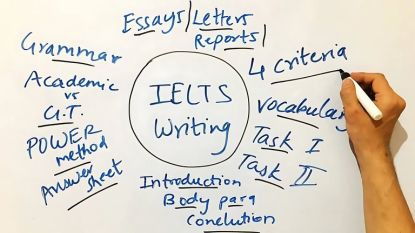
The four IELTS Writing criteria check whether you answered the actual question, whether your essay is organised and linked logically, how precisely you use vocabulary, and how varied and accurate your grammar is. Each criterion is rated separately, so you need to know which one is weakest before you can fix it.
The criterion names below match the official IELTS Writing band descriptors (IELTS, 2023). The explanations are written in plain English.
Task Response measures how fully and relevantly you answer every part of the prompt and how clearly you state and support a position. At band 7, the descriptors say "main ideas are extended and supported but there may be a tendency to over-generalise or there may be a lack of focus." At band 6, some main ideas "may be insufficiently developed or may lack clarity" (IELTS, 2023). The difference between those two bands is mostly about development, not difficulty.
Coherence means your ideas follow a logical order that a reader can follow easily. Cohesion is the set of tools that join those ideas together: linking words, pronouns such as "this" and "they", and clear paragraphing. A high Coherence and Cohesion score comes from a natural flow, not from starting every sentence with "Moreover".
Lexical Resource is the range and precision of your vocabulary, including collocation (words that naturally go together, such as "make a decision") and spelling. Using one accurate, everyday phrase usually scores better than forcing in a rare word with the wrong meaning.
Grammatical Range and Accuracy looks at whether you use a mix of sentence structures and how many of your sentences are free of errors. Complex sentences only help when they are correct. Punctuation is also part of this criterion.

A Task 2 score usually stops improving because the same few weaknesses appear in every essay: partly answered questions, ideas that are listed rather than explained, formulaic linking and repeated grammar mistakes. Writing more essays without feedback simply repeats those weaknesses. Each problem below links to a specific criterion.
To plan an IELTS Writing Task 2 essay in 5 minutes, identify the question type, decide your position, choose two main ideas with a reason and example for each, then check your plan against every part of the prompt. This short plan protects Task Response and Coherence before you write a single sentence.
Use this minute-by-minute routine:
Here is a sample plan for a common question type: "Some people think universities should mainly teach job skills. Others believe they should teach knowledge for its own sake. Discuss both views and give your opinion."

A four-paragraph structure works for almost every Task 2 question: an introduction, two body paragraphs and a short conclusion. Each body paragraph should start with a clear topic sentence, then explain it, give an example and link back to the question. This shape keeps your ideas developed and easy to follow.
The word counts below are our suggestion, not an official rule. They add up to roughly 270 to 300 words, safely above the 250-word minimum.
The explanation sentence is where most band 6 essays fall short. After your topic sentence, ask yourself "why?" or "how?" and answer that in one or two sentences before you give your example.
Marked essays improve your IELTS writing score faster because feedback shows you which criterion is limiting your band and which errors you keep repeating. Unmarked practice builds speed, but it also reinforces the same mistakes. A marked essay followed by a focused rewrite turns each weakness into a specific task to fix.
Model answers are useful too. Free sites such as IELTS Liz and official IELTS practice materials provide Task 2 sample answers and real question topics. A model answer, however, cannot tell you which of your own sentences cost you a band.
Try this weekly routine:
At Study Smart, our online IELTS course includes detailed trainer feedback on 20 writing and speaking tasks (Study Smart, 2026). Results differ from student to student, and no trainer can honestly promise a particular band.
If you are aiming for a 2027 intake, your IELTS result needs to be ready before your application deadlines, with enough time left for a retake if Writing lets you down. Many universities set minimum scores for each section as well as an overall band, so check each course page early. Writing is often the section that stops applicants from meeting the requirement.
Here is how to use this guide:
For the full picture of all four IELTS sections, read our IELTS preparation guide. Once your score is ready, our team can help with the next steps, including applying to foreign universities.
There is no fixed timeline, because it depends on which criterion is holding you back. A Task Response problem can sometimes be fixed in a few weeks of marked practice, while deep grammar habits take longer. A diagnostic essay marked by criterion gives you a realistic starting point.
Yes. 250 words is a minimum, and essays that fall short may not show enough for the higher bands. Aiming for about 270 to 300 words leaves you time to plan and check without adding extra errors.
You need precise vocabulary more than rare vocabulary. Lexical Resource rewards accurate word choice, natural collocations and correct spelling. A simple word used correctly is safer than an impressive word used slightly wrongly.
A reusable paragraph structure is fine and helpful. Memorised sentences and stock phrases are risky, because examiners look for language that responds to the actual prompt. The official descriptors rate a totally memorised answer at Band 0.
Official IELTS practice materials and the Cambridge IELTS practice books contain real-style questions on common topics. Practise across all five question types so no format surprises you on test day. Have your answers marked so each practice essay shows you what to fix next.
If your Writing score has stalled, the next step is finding out exactly why. Book a free diagnostic test and trial class with a certified Study Smart IELTS trainer, in Pune, Delhi or online, and get a clear plan for your weakest criterion. Contact Study Smart to book your session.