-1751978393.webp)
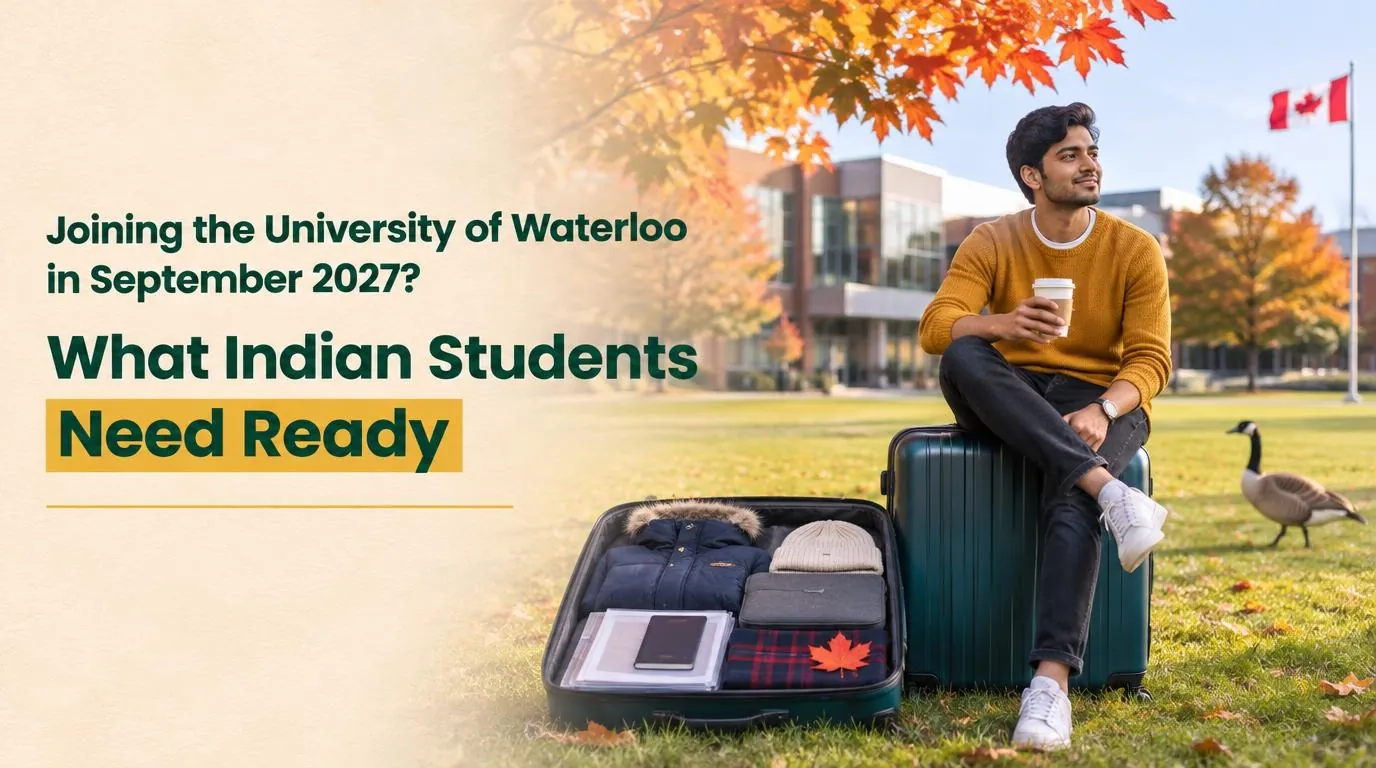
The University of Waterloo for Indian students is a top choice if you want paid work experience built into your degree. But the September 2027 intake has tight dates. Engineering applications close on January 15, 2027. Most other undergraduate programmes close on February 1, 2027 (University of Waterloo, 2026).
Canada's study permit rules also treat undergraduates and master's students very differently. This checklist walks you through each step in order. We checked every detail against official Waterloo and IRCC pages in November 2026.
At a glance
Apply as an undergraduate if you are in Class XII now. Apply as a graduate student if you already have a bachelor's degree or will finish one before September 2027. The two routes use different systems, documents, deadlines and English rules. The biggest gap is the study permit. Undergraduates still need a PAL, while master's and PhD students at public universities do not.
Here is how the two routes compare:
Waterloo asks for First or Second Division in the CBSE, ISC or a similar Class XII certificate. Admissions reviews your Class X board results, final Class XI grades and predicted Class XII results. Each programme then adds its own required subjects and minimum marks. Always check the page for your exact programme.
Computer Science is a good example of how strict the uwaterloo admission requirements can be. It asks for Class XII Mathematics (at least 90%), one other Class XII course (at least 90%) and English, plus at least 85% overall in Class XII. Applied Mathematics is not accepted, and the AIF is required (University of Waterloo, 2026). CBSE students who chose Applied Mathematics should note this early.
These figures are minimums. Meeting them does not promise an offer, because popular programmes get far more applicants than seats. Many students search for the uni of Waterloo or UWaterloo, but the official rules always sit on uwaterloo.ca pages.
For graduate study, Waterloo asks for at least 75% overall in a four-year honours bachelor's degree or equivalent (University of Waterloo, 2026). That page does not mention three-year Indian degrees. If you hold a three-year degree, write to your target department before you apply.
Most Indian applicants should plan to take an English test. For undergraduate entry, Waterloo asks for IELTS Academic 6.5 overall. You need 6.5 in writing and speaking and 6.0 in reading and listening. Graduate programmes set their own scores. Check your department's page before you book a test date.
Waterloo lists these undergraduate options (University of Waterloo, 2026):
Your test must be taken on or after May 1, 2025. Waterloo does not accept TOEFL MyBest scores. A test can be waived if your four most recent years of full-time study were in an English-language school system. The page does not name Indian boards, so check your Declaration of Academic Experience in the applicant portal. If you think you qualify, ask your school for a principal's letter confirming English-medium teaching, and confirm with Waterloo before you skip the test.
Graduate applicants face extra rules. Scores are valid for two years, and the required score must come from a single sitting. IELTS One Skill Retake is not accepted (University of Waterloo, 2026). If you need to lift your band score fast, our IELTS, PTE and TOEFL coaching can help you plan a test date that fits the deadlines.
Choose co-op if you want paid Canadian work experience before you graduate. At Waterloo, co-op students switch between study terms and four-month work terms. Most co-op degrees take about one year longer than regular degrees. In return, you build a real work history in Canada while you study.
Waterloo co-op students can graduate with up to 24 months of paid work experience (University of Waterloo, 2026).
Here are the key co-op facts from the same Waterloo page:
Co-op pay can ease costs in later years. But do not count it in your first-year budget. IRCC wants to see your money before you arrive, so plan your funds as if co-op pay did not exist.
For undergraduates, the timeline is short. Engineering closes on January 15, 2027, and most other programmes close on February 1, 2027. Documents are due about two weeks after each deadline. Graduate deadlines differ by department, so check your programme page this week and work backwards from that date.
Use this step-by-step plan for an undergraduate application:
Undergraduates mainly send board marks, an English score and supplementary forms like the AIF. Graduate applicants send transcripts, reference letters, an English score and a statement of purpose when the programme asks for one. Whichever route you take, keep every name, date and mark the same across all your documents.
A simple document checklist (our advice, so confirm each item in your Waterloo portal):
A strong SOP is specific. Name the programme and explain why it fits your goals. Link your past projects or work to what you want to study. For research degrees, mention the faculty work that interests you. Avoid general praise of Canada, because it tells the committee nothing about you.
Canada still limits new study permits. Undergraduates need a PAL from Ontario, and their applications count against Ontario's share of the cap. Master's and PhD students at public universities like Waterloo do not need a PAL. Every student still needs an offer letter, proof of funds and a complete permit application.
For 2026, IRCC planned up to 408,000 study permits, including 155,000 for new students. Ontario received 104,780 application spaces for students who need a PAL (IRCC, 2025). For 2027, Canada's new levels plan targets up to 150,000 new international students (IRCC, 2026). At the time of writing, IRCC had not published the 2027 cap split by province.
Timing matters for undergraduates. PALs issued in 2026 expire on December 31, 2026 (IRCC, 2026). So a September 2027 undergraduate will need a PAL issued under the 2027 cap. Master's and PhD students skip this step, which is a real advantage for graduate applicants.
You must also show CAD 23,448 for one year of living costs, plus your tuition and travel (IRCC, 2026). Our student visa and interview preparation service helps you put these papers in order.
Plan for tuition plus living costs. Waterloo's estimates for September 2026 starters range from about CAD 51,000 to 75,000 for first-year tuition and incidental fees. IRCC also asks you to show CAD 23,448 for one year of living costs. Fees for September 2027 starters may be higher, so add a safety margin.
The Waterloo university fee structure for international students is set by programme (University of Waterloo, 2026):
Many families combine savings with an education loan. If you plan to use a student loan, start the bank process early. A sanction letter takes time, and you need it for the permit file.
The University of Waterloo for Indian students works best when you plan around three dates: your English test, your application deadline and your permit filing. Here is what to do now:
Study Smart counsellors in Pune and Delhi NCR help students with each of these steps, from IELTS coaching to SOP review and visa papers. Book a counselling session through our guided foreign university application service to get your personal Waterloo plan before the 2027 deadlines.
We could not find an official acceptance rate for Indian students on Waterloo's pages. Popular programmes like Computer Science and Engineering are very competitive. Aim well above the published minimums and submit a strong AIF.
Most do. Waterloo can waive the test if your last four years of full-time study were in an English-language school system, but it does not name Indian boards. Check your Declaration of Academic Experience in the portal, and book a test if you are unsure.
No. Since January 1, 2026, master's and PhD students at public universities do not need a PAL. You still need an offer letter, proof of funds and a complete study permit application.
Waterloo's graduate page asks for a four-year honours bachelor's degree or equivalent. The page does not say how it treats three-year degrees. Email your target department before you apply.
For September 2026 starters, first-year tuition and incidental fees run from about CAD 51,000 to 75,000. Add CAD 23,448 in living funds for the study permit, plus books and travel. Expect 2027 fees to be similar or higher.













 -1769497776.jpg)
 A Complete Study Guide-1768995135.jpg)