-1751978393.webp)

When the US announced the $100K H-1B fee in September 2025 (USCIS, 2026), many Indian families worried that a US degree had lost its biggest payoff. The detailed rules tell a different story. Students who switch from F-1 to H-1B status without leaving the US were left out of the payment. That gives US graduates a real edge over workers hired from abroad (The PIE News, 2025).
At a glance
The new H-1B payment is a one-time $100,000 charge that a US employer must make with certain new H-1B petitions, created by a presidential proclamation signed on 19 September 2025 (USCIS, 2026). The charge mainly targets workers outside the US who need a new visa. Students already in the country with valid status were not the main target.
The H-1B is the main US work visa for graduates in specialised jobs such as software, engineering, data science and finance. A petition is the application an employer files with US Citizenship and Immigration Services (USCIS) to sponsor a worker. Visas issued before the cut-off are not affected, and the payment does not change the fees for H-1B renewals (USCIS, 2026).
The jump in cost is large. Employers typically paid $2,000 to $5,000 for an H-1B application before the proclamation (The PIE News, 2025). The employer pays the new amount, not the student or the student's family.
The new H-1B fee mostly hits people hired from abroad, so graduates already in the US become the easier and cheaper hire. A company weighing a candidate in India against an equally skilled US graduate on F-1 status now faces a much bigger bill for the overseas candidate. For employers, the graduate already on campus is the simpler choice.
Here is an example to make the point concrete. Picture Riya, a Pune engineer finishing a master's in data science in Texas, and Arjun, an equally skilled analyst in Bengaluru. If one US company wants to hire both, only Arjun's new petition would trigger the payment, because Riya can change status inside the US (BakerHostetler, 2025). Riya and Arjun are illustrations, not real cases, but the logic follows the published guidance.
This matters because US employers want trained talent at a predictable cost. A US degree now does two jobs at once: it builds skills, and it places the student inside the country where the cheaper hiring route is available. For Indian families comparing the US with other destinations, that is a meaningful shift in the value of a US education.
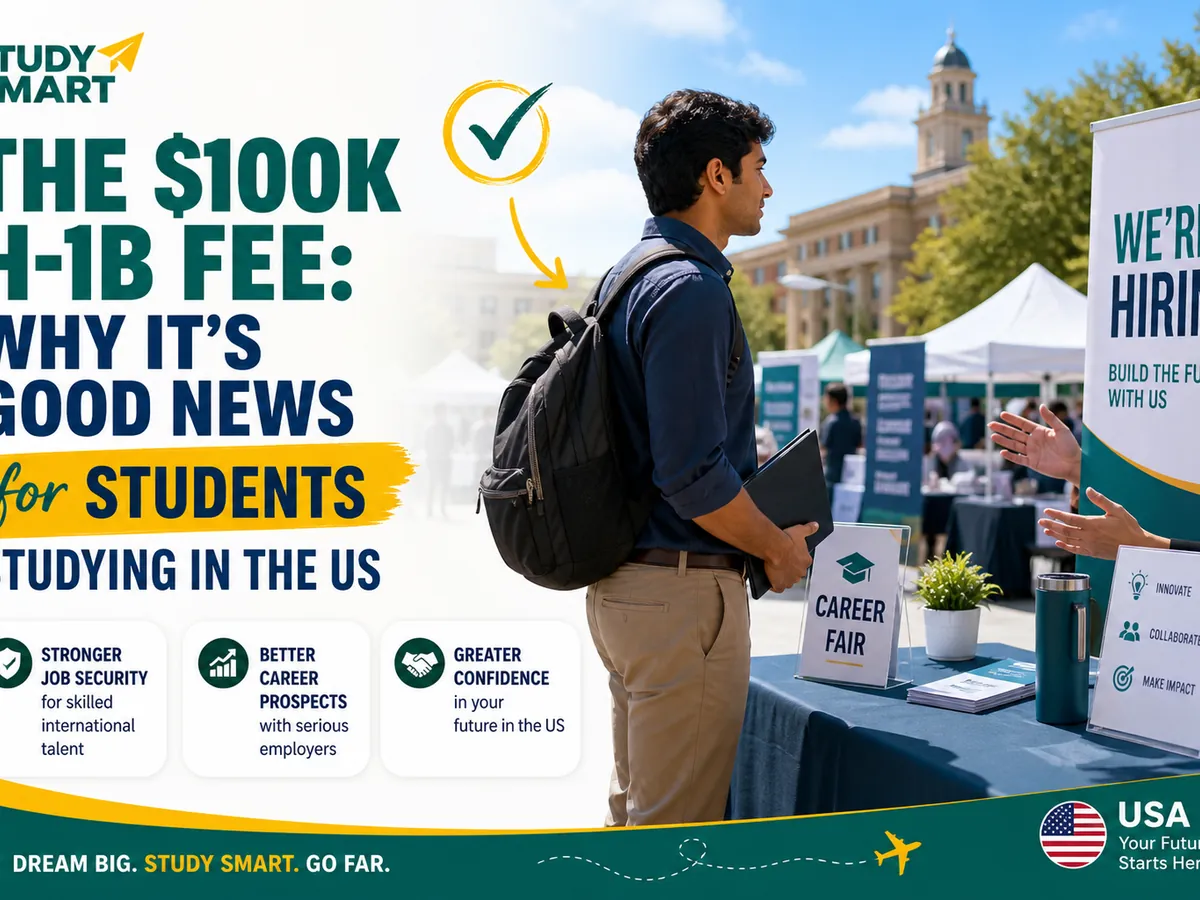
No, in most cases the H-1B fee for F-1 students does not apply when the student moves from OPT to H-1B without leaving the US. USCIS treats that switch as a change of status, and changes of status were left out of the payment under guidance clarified in October 2025 (The PIE News, 2025).
Optional Practical Training (OPT) is the work permission F-1 students get to gain job experience in their field after graduation. Many students then move from OPT to H-1B when an employer sponsors them. An H-1B change of status means USCIS approves the new status while the student stays in the US, so no new visa from abroad is needed for that step.
F-1 students physically in the US who are eligible to change status to H-1B are not required to pay the $100,000 fee, and they stay exempt if they later travel abroad on the approved petition (BakerHostetler, 2025).
There are limits. The payment applies to people inside the US who are not eligible for a change of status, so a student whose F-1 status has lapsed could fall back into the paid group (BakerHostetler, 2025). A student who leaves the US before the petition is approved may also face the fee. That point is our reading of the guidance, so confirm it with an immigration attorney before you travel.
As of November 2026, employers are not required to pay the $100,000 fee because two federal courts have blocked it. USCIS has said it will comply with those orders, but the government is appealing both rulings, so the fee could return (Ahluwalia Law Offices, 2026).
The legal path has been busy. Here are the main steps:
December 2025: A federal court in Washington, D.C. upheld the fee in a US Chamber of Commerce case, which is now on appeal (Ahluwalia Law Offices, 2026).
June 2026: A Massachusetts federal court ruled for 20 states on 8 June 2026, calling the fee an unlawful tax (Ahluwalia Law Offices, 2026).
July 2026: The First Circuit refused to pause that ruling on 24 July 2026, and DHS said it would comply while it considers next steps (USCIS, 2026).
September 2026: A second proclamation on 18 September 2026 extended the payment rule through 21 September 2027 (Ahluwalia Law Offices, 2026).
What this means for 2027-intake students: If you start a US degree in 2027, you will likely reach the H-1B stage between 2028 and 2030. The proclamation's payment rule, and the change of status exemption that comes with it, currently runs only through 21 September 2027. That is before you graduate. The proposed $103,265 rule would charge cap-subject change of status petitions, and it is the rule more likely to apply to you unless it changes before it is finalised. Three steps to take now:
Late September 2026: A California federal court blocked the agency policies carrying out the fee on 30 September 2026, and the government appealed on 9 October 2026 (Ahluwalia Law Offices, 2026).
For students, the takeaway is simple. The fee is paused, not cancelled. USCIS has stated that if the court order is lifted, DHS still plans to collect the payment (USCIS, 2026).
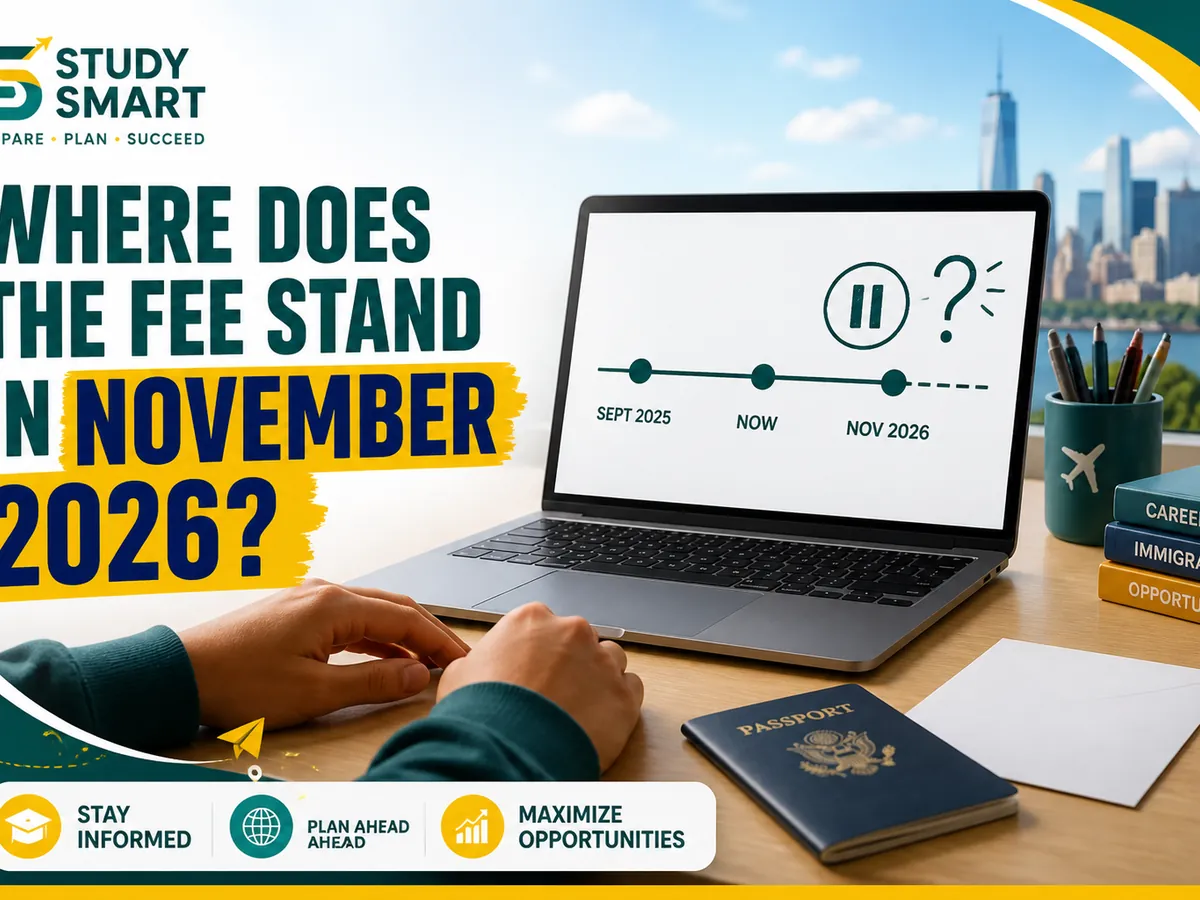
The $103,265 H-1B fee is a separate proposal from the Department of Homeland Security (DHS), published on 25 August 2026. It would apply to every H-1B petition subject to the annual cap, including petitions for people already in the US who convert to H-1B (KFF, 2026).
That last detail is the one students should watch. The 2025 proclamation spared most change of status cases, but the new proposal would not. Public comments closed on 24 September 2026, and the rule could take effect as early as March 2027, when registration for the next H-1B cap opens (KFF, 2026).
The proposal still has gaps that help some graduates. Extensions, amendments and transfers would not be charged, and cap-exempt employers such as universities, government research organisations and certain nonprofits would be exempt (KFF, 2026). The cap is the yearly limit of 65,000 new H-1B visas, plus 20,000 more for people with a US master's degree or higher (Ogletree, 2025). The proposal is not in effect yet and may change before it is finalised.
The wage-weighted H-1B lottery gives more chances to job offers with higher salaries. DHS finalised the rule in December 2025, and it took effect on 27 February 2026 for the FY 2027 cap season (Ogletree, 2025). Salary level now affects your odds directly.
The system uses four wage levels, set by government wage surveys for each job type and location. Each candidate's entries depend on the highest level the offered salary meets:
Students care about this change. In a NAFSA survey reported in 2025, 53% of postgraduate students said they would not have enrolled at US institutions if H-1B access depended on wage levels (The PIE News, 2025). Fresh graduates often start at lower wage levels, so the choice of course, university and city now matters more than before.
The cost of an H-1B hire now depends on where the candidate is and which rule applies. A graduate inside the US has the clearest advantage under the 2025 proclamation, while the proposed rule would narrow that gap (KFF, 2026).
At a glance
For Indian students and parents, the policy still favours studying in the US over applying for US jobs from India. The advantage depends on staying in valid status, earning a strong salary offer and tracking the proposed rule. These steps help you plan around the risks:
Parents can take some comfort in one fact: the employer pays the H-1B fee, not the family. Your planning budget should still cover tuition, living costs and a buffer for the job search. If you are just starting, our step-by-step page on how to apply to foreign universities explains the admissions timeline.
In most cases, no. USCIS guidance says F-1 students who are in the US and eligible to change status to H-1B are not required to pay it (BakerHostetler, 2025). The employer files a change of status petition instead of a new visa from abroad.
No. As of November 2026, two federal courts have blocked the fee and USCIS has said it will comply (Ahluwalia Law Offices, 2026). The government is appealing, so the fee could come back.
It could. The $103,265 proposal from August 2026 would apply to cap-subject petitions for people already in the US who convert to H-1B (KFF, 2026). The rule is not final, and cap-exempt employers would not pay it.
The sponsoring employer pays it through pay.gov before filing the petition. USCIS refunds the payment if the petition is denied (BakerHostetler, 2025).
For many students, yes, because the 2025 rules, when enforced, favour graduates already in the US, though the proposed $103,265 fee could narrow that gap. The value depends on your course, expected salary and backup plans. A counsellor can help you test those factors against your budget.
H-1B rules are changing fast, and the course, university and timeline choices you make today shape your options after graduation. StudySmart counsellors in Pune and Delhi help students and parents build a plan with a strong backup, so you are prepared as the court cases develop. Book a study abroad counselling session to map your US route and a strong backup country.




-1766748863.jpg)

























 (4)-1792570898.png)