-1751978393.webp)

If your US, Canada or UK plan stalls because of a rejected admit, a visa delay or a budget gap, you do not have to lose a year. Germany, Ireland and France are three of the strongest Plan B countries to study abroad for Indian students right now. Each one has a legal route to stay and look for work after graduation, and Germany and France charge far less tuition than most Plan A destinations.
This guide compares all three using official government and university sources, so you and your parents can pick a backup that still moves your career forward.
Indian students need Plan B countries to study abroad because a single-country plan carries too much risk. One visa refusal, one policy change or one missed deadline can push your start date back a full year. Applying to a backup country at the same time protects your timeline, your money and your momentum.
At StudySmart, our counsellors in Pune and Delhi NCR often meet students who applied to only one country and then had to wait when things went wrong. A planned backup changes the question from "What now?" to "Which offer do I accept?"
Germany, Ireland and France work well as backups for three reasons:
For a wider view of every destination, see our guide to the best country to study abroad for Indian students.
In the Germany vs Ireland vs France comparison, Germany wins on tuition, Ireland wins on English-language study and simple work rules, and France sits in the middle with fixed public fees and an extended stay-back route for Indian master's graduates. The right Plan B depends on your budget, your field and your willingness to learn a second language.
At a glance
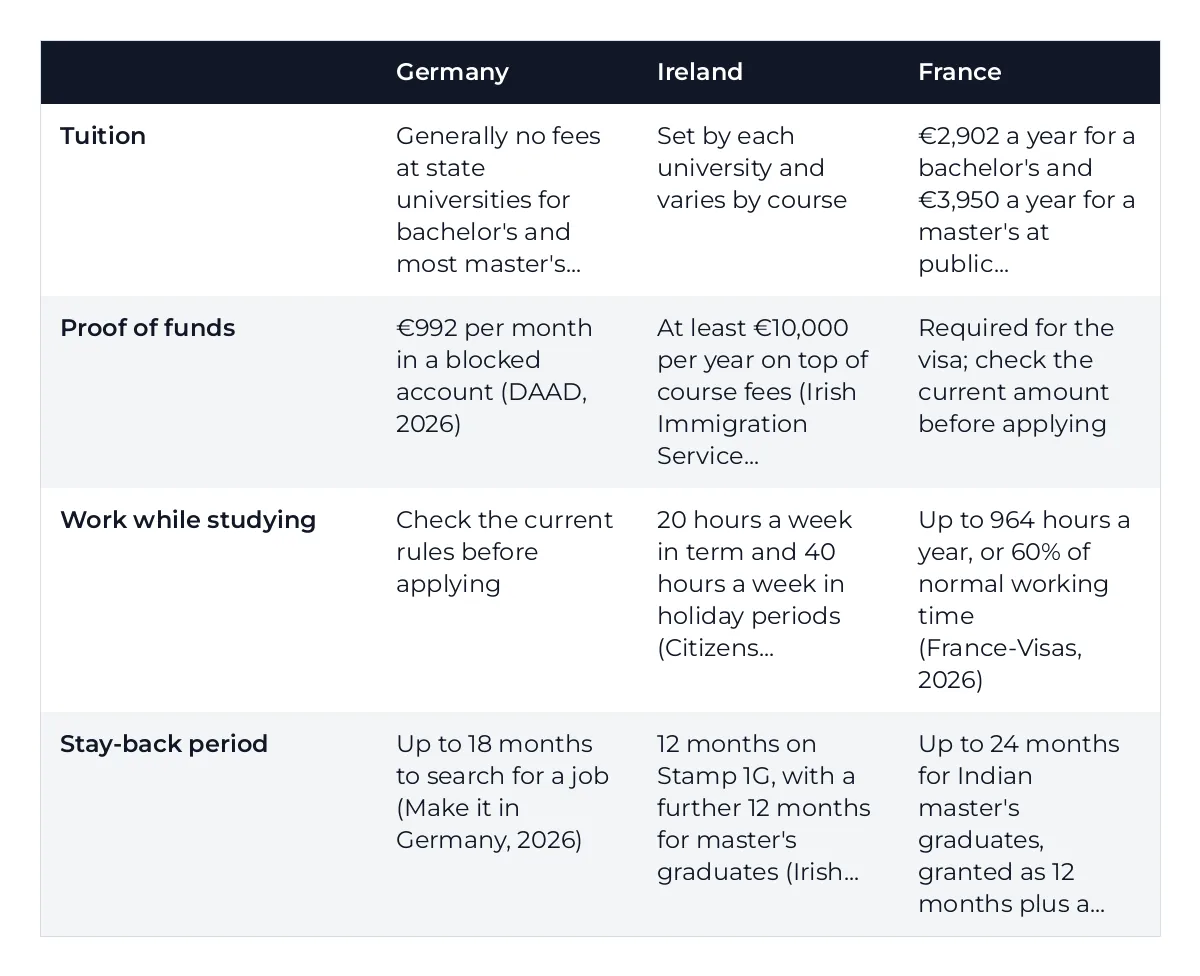
At a glance
These are the latest official figures published for 2026. Amounts usually change each year, so check the official pages before you apply for a 2027 intake.
Germany is the strongest Plan B for students who want to keep tuition close to zero. State universities generally charge no fees for bachelor's courses or most master's courses, and graduates get time to stay and search for a job. The main trade-offs are competitive admissions and a job market that often expects some German.
Germany's fee rules are set by each federal state. Always check each university's fee page, because some states charge non-EU students tuition. The main exceptions are Baden-Württemberg, which charges non-EU students €1,500 per semester, and Bavaria, where some universities may charge non-EU students several thousand euros per semester (DAAD, 2026). Every student also pays a semester contribution, a fee that covers student services and often a public transport ticket, of between €70 and €430 (DAAD, 2026).
German state universities generally charge no tuition for bachelor's courses or most master's courses (DAAD, 2026).
The real cost of studying in Germany per month comes from rent and daily living, not tuition. German students spend an average of €876 a month, according to a national student survey quoted by DAAD (DAAD, 2026). DAAD suggests planning for €900 to €1,200 a month, depending on the city (DAAD, 2026).
Rent is the biggest single line. The same survey puts average rent, including utilities, at €410 a month (DAAD, 2026). Big cities such as Munich usually cost more than smaller university towns, so your city choice matters as much as your university choice.
Germany asks non-EU students to prove they can cover these costs through a blocked account, which is a bank account you fund in advance and draw from in fixed monthly amounts. The required amount is €992 per month (DAAD, 2026).
Who Germany suits best: engineering, computer science and science students with strong academic records who are ready to start learning German before they fly.
Ireland is the best Plan B for students who want to study and work entirely in English. Teaching, daily life and most graduate jobs run in English, and the student work rules are simple to follow. The trade-off is higher tuition than Germany or France and a high cost of living in Dublin.
Ireland's official student finance rules (Irish Immigration Service Delivery, 2025) ask you to show at least €10,000 per year for living costs, on top of your course fees (Irish Immigration Service Delivery, 2025). Tuition is set by each university and varies a lot by course, so always check the fee page of the exact programme you plan to apply for.
Irish work rules are easy to plan around. Non-EEA students on a full-time course can work 20 hours a week during term and 40 hours a week in set holiday periods (Citizens Information, 2026). That income helps, but it should not be the main way you plan to pay for your living costs.
Stamp 1G is Ireland's permission for graduates to stay and look for work, officially called the Third Level Graduate Programme. Bachelor's (Level 8) graduates get 12 months, while master's (Level 9) graduates get 12 months that can be renewed once for another 12 months (Irish Immigration Service Delivery, 2025). Stamp 1G in Ireland after a master's therefore gives you up to two years to find a job and move to a work permit.
Who Ireland suits best: students in technology, data, business analytics, finance and pharma who want an English-only path and are comfortable with higher upfront costs.
France is the most underrated of the three. Public university fees for non-EU students are fixed nationally, many master's programmes at business and engineering schools are taught in English, and Indian master's graduates get a longer stay-back route than the standard one. The trade-off is that daily life and many jobs still expect working French.
For the 2026-27 academic year (the latest published figures, so 2027-28 fees may differ), non-EU students at public institutions pay €2,902 a year for a bachelor's and €3,950 a year for a master's (Campus France, 2026). Campus France also notes that some students are exempt from these fees and that institutions may grant waivers, so ask each university about fee reductions. Private business schools set their own, much higher fees.
France gives students a work allowance counted in hours per year rather than per week. You can work up to 964 hours a year, which equals 60% of normal full-time working time (France-Visas, 2026). That yearly limit gives you room to work more in holidays and less during exams.
Who France suits best: management, luxury and fashion business, hospitality, aerospace and engineering students who are open to learning French alongside their degree.
If you compare the post-study work visa Germany Ireland France routes for a master's graduate, Ireland and France offer up to 24 months, while Germany offers up to 18 months. All three are job-search periods: once you find a suitable job, you switch to a regular work or residence permit.
Here is how each route works for an Indian master's graduate:
The length of the stay-back period is only half the story. Your chances also depend on whether your field is in demand and whether you speak the local language. A shorter route in a country where you speak the language can beat a longer route where you do not.
The safest timeline runs your Plan B in parallel with Plan A, starting about a year before your intake. Build one core document set, adapt it for each country, and apply to your backup before your Plan A results arrive. Deadlines differ by university, so always confirm dates on each official course page.
If budget is a worry, read our guide on how to get scholarships to study abroad before you finalise your list.
The examples below are illustrative profiles based on the kinds of cases our counsellors see, not real student records. They show how the same Plan B decision can lead to different countries.
Example one: a mechanical engineering graduate from Pune. Her US admits came through but her funding fell short. Germany fits best: a state university keeps tuition near zero, her engineering background suits German industry, and she can start learning German before departure.
Example two: a commerce graduate from Delhi NCR with two years in analytics. He wanted the UK but faced a delayed decision. Ireland fits best: he can study and work fully in English, and Stamp 1G gives him time to find an analytics role.
A French business school could also suit the second student if he is open to learning French. Real decisions depend on many more details, which is why a one-to-one profile review matters.
Choosing between Plan B countries to study abroad is not about picking the cheapest option. It is about picking the backup you would still be happy to accept if Plan A fails. Use this simple checklist:
Our counsellors in Pune and Delhi NCR can review your profile, prepare your IELTS plan and build one document set that works for both your Plan A and Plan B countries.
Germany is usually cheaper because state universities generally charge no tuition for bachelor's and most master's courses. Ireland charges tuition that varies by course and also asks for proof of living funds. Your total cost still depends on the city you choose in either country.
Yes, many master's programmes in Germany and France are taught in English. However, part-time jobs, daily life and many graduate roles often expect the local language. Starting German or French lessons early improves your career chances.
Ireland is often easier for English-only speakers because most workplaces operate in English. Germany and France offer strong job markets in engineering and business, but local-language skills usually make a big difference. Match the country to your field and language plans.
Apply at the same time as your Plan A, roughly six to nine months before your intake. Waiting for Plan A results first often means missing Plan B deadlines. Prepare one core document set early so both applications move together.
In a separate, real review of our counselling, StudySmart student Priya Choudhary wrote that the team "gave me a comprehensive comparison of the top study destinations like Australia, Germany, and Ireland."
Book a free session with our counsellors for expert study abroad counselling. We will compare Germany, Ireland and France against your profile, budget and career goals, and help you apply to both plans with confidence.




-1766748863.jpg)





















 (4)-1792570898.png)