-1751978393.webp)

From 1 January 2027, the UK Graduate visa for most graduates drops from two years to 18 months (GOV.UK, 2026). Ireland still gives master's graduates up to two years (Irish Immigration Service Delivery, 2024). That change has reopened the Ireland vs UK for Indian students question.
The right answer now depends on your degree level, your budget and the career you want. This guide puts the official rules for both countries side by side, so you and your parents can decide on facts instead of guesses.
At a glance
The UK Graduate visa lets you stay and work after your degree. If you apply on or after 1 January 2027, it will last 18 months instead of 2 years. The length depends on the date you apply, not the date your course starts. PhD graduates still receive 3 years (GOV.UK, 2026).
Students searching for the UK Graduate visa 18 months 2027 rule usually want to know if it applies to them. For anyone joining a UK course in 2027, the answer is yes, under the current rules: they will graduate after the cutoff, so the 18-month rule covers them (GOV.UK, 2026).
The fees below were correct at the time of writing (November 2026). UK visa fees are usually reviewed each year, so check GOV.UK before you apply. The Graduate visa application fee is £937. The Immigration Health Surcharge (the fee for access to the NHS, the UK's public health service) is usually £1,035 for each year you hold the visa (GOV.UK, 2026).
From 1 January 2027, a UK Graduate visa for bachelor's and master's graduates lasts 18 months, not 2 years (GOV.UK, 2026).
The Home Office's own impact assessment expects the shorter visa to cut student visa applications by about 12,000 a year in the long term (ICEF Monitor, 2025). Two other parts of the same package are worth knowing:
Ireland's Third Level Graduate Programme gives eligible graduates Stamp 1G permission. Master's (Level 9) graduates get 12 months at first. They can renew for another 12 months by showing they have been actively looking for graduate-level work, so the total is up to 24 months. Honours bachelor's (Level 8) graduates get 12 months (Irish Immigration Service Delivery, 2024).
Two terms need explaining. NFQ is Ireland's National Framework of Qualifications: Level 8 is an honours bachelor's degree, and Level 9 is a master's degree or postgraduate diploma. Stamp 2 is the student permission you hold during your course. Stamp 1G is the graduate permission you move to after it.
The main condition for Ireland Stamp 1G after master's graduation is timing. You must apply within six months of being told you have achieved your award (Irish Immigration Service Delivery, 2024). The other official conditions are:
The renewal is not automatic. Keep records of every application, interview email and agency sign-up from your first month on Stamp 1G, because those records support your renewal request.
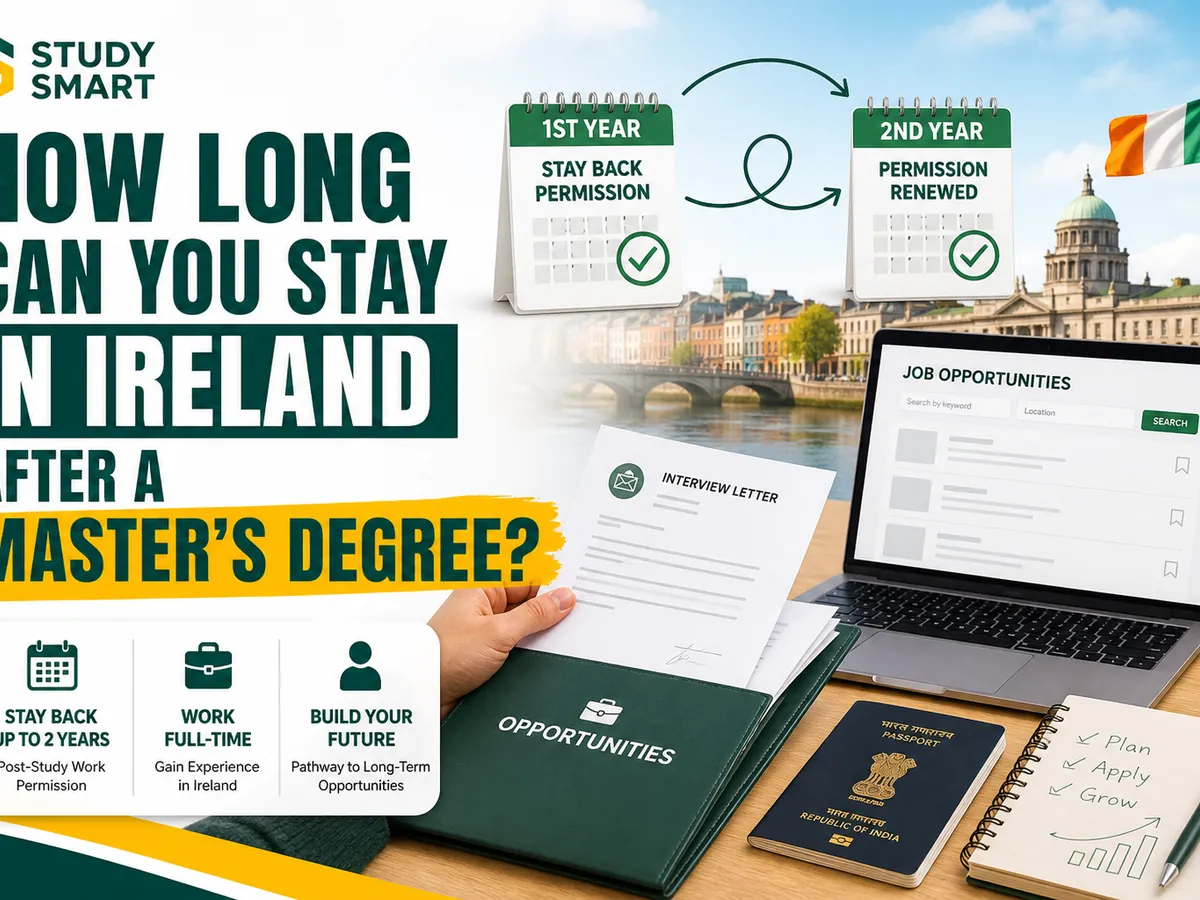
On the Ireland vs UK post-study work visa question, your degree level decides the winner. Master's graduates can get more time in Ireland. Bachelor's and PhD graduates get more time in the UK. The details for each degree level are below.
Length is only part of the picture. The UK visa runs as one block, while Ireland's master's route has a checkpoint in the middle. Ireland's longer window is worth the most to students who start applying for jobs early and keep proof of their job search.
Both countries ask you to prove you can pay your living costs. Ireland's figure covers a full year in euro, while the UK figure covers up to nine months in pounds, so convert both into rupees before you compare them. Ireland asks for €10,000 a year. The UK asks for a monthly amount for up to nine months, and the figure is higher in London (Irish Immigration Service Delivery, 2025; GOV.UK, 2026).
Here is how the visa-funds rule works in each country:
These are visa minimums, not a full budget. Rent, travel and tuition fees all come on top, and fees vary by university and course. Before you compare the Ireland vs UK cost for Indian students, convert both currencies into rupees at the rate on the day you plan to pay. A gap between the euro and the pound can change which country is cheaper.
Ireland also says you should not count on casual part-time work to meet the funds rule (Irish Immigration Service Delivery, 2025). Parents should plan to have the full amount in place before the visa application, not after arrival. Our guide on how to get scholarships to study abroad explains how scholarships can lower the tuition part of the bill.
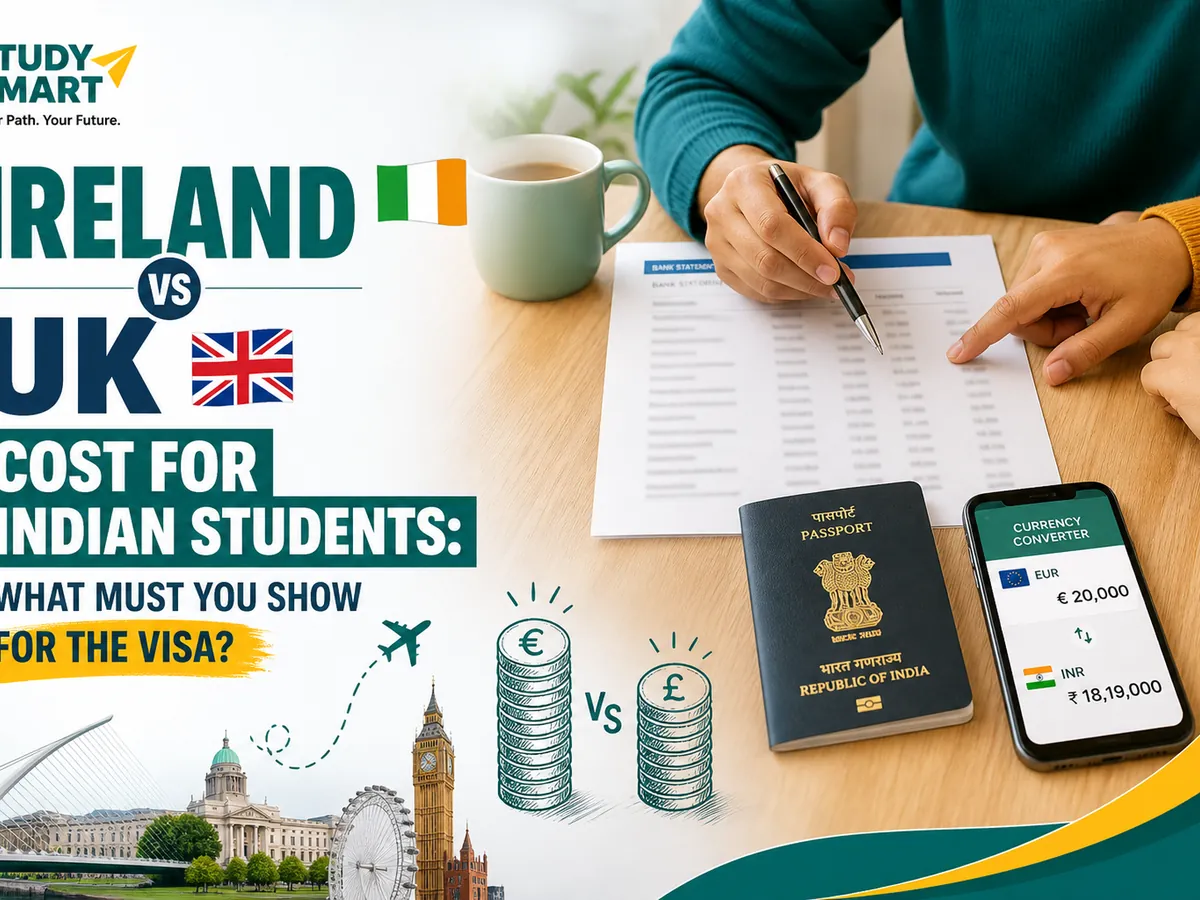
If you study in Ireland vs UK, you can work part time in both countries, but the rules are set differently. Ireland sets one clear limit for students on Stamp 2. The UK limit depends on your course level and whether it is term time (Irish Immigration Service Delivery guidelines, 2011; GOV.UK, 2026).
In Ireland, non-EEA students with a current Stamp 2 can work up to 20 hours a week in term time. They can work up to 40 hours a week during normal college holidays (Irish Immigration Service Delivery guidelines, 2011).
In the UK, students on a full-time course at degree level or above can usually work up to 20 hours a week in term time, and students on a full-time course below degree level can usually work up to 10 hours (GOV.UK, 2026). GOV.UK says how much you can work depends on what you study and whether you are in or out of term time (GOV.UK, 2026). Check the work conditions shown on your eVisa or visa decision letter, because that limit applies to you. Treat part-time earnings in either country as pocket money, not as the way you pay rent or fees.
The UK is strict about family members for most master's students. If your postgraduate course starts on or after 1 January 2024, you can only bring dependants if it is a PhD, another doctorate or a research-based higher degree (GOV.UK, 2026). That means most taught master's students from India will travel alone.
In general, Ireland does not allow family members to join non-EEA students who hold a student permission such as Stamp 2, and family members must apply for a visa in their own right (Irish Immigration Service Delivery, 2026). Ireland's family reunification policy does not cover students, except PhD students and certain approved scholarship holders. It also does not cover graduates on the Third Level Graduate Programme (Irish Immigration Service Delivery, 2026). If you are married or plan to travel with a family member, ask a counselor to check the current Irish Immigration Service Delivery position before you choose a country.
Neither country is better for everyone. Ireland suits most taught master's students who want the longest job search window. The UK suits bachelor's graduates, PhD candidates and students who want a wider choice of universities and cities. Your degree level and career plan should decide.
Ireland may be the smarter choice if you:
The UK may be the smarter choice if you:
For a wider view of the options, see our guide to the best country to study abroad for Indian students.
The two cases below are illustrations we built from the official rules. They are not real student records. They show how the same rules can point two families in different directions.
Case one: a data analytics graduate from Kothrud, Pune. She is choosing between a one-year master's in Dublin and one in Manchester. In Dublin, she could hold Stamp 1G for up to 24 months if she renews (Irish Immigration Service Delivery, 2024). In Manchester, she would get 18 months (GOV.UK, 2026).
Her visa funds proof is €10,000 for Ireland or £10,539 for a UK city outside London. Converted to rupees, the UK figure is higher (Irish Immigration Service Delivery, 2025; GOV.UK, 2026). For her, Ireland's extra job-hunting time is the deciding factor.
Case two: a commerce school-leaver from Dwarka, Delhi. He wants a bachelor's in business. Under current rules, a UK degree would give him an 18-month Graduate visa, while under current rules an Irish honours bachelor's would give him 12 months on Stamp 1G (GOV.UK, 2026; Irish Immigration Service Delivery, 2024). For him, the UK still offers more time after graduation.
If you are weighing Ireland vs UK for Indian students in the coming intakes, focus on rules you can check, not on headlines. Here is a simple plan you and your parents can follow.
Students who have worked with our counselors often tell us that an honest list of pros and cons helped them more than a sales pitch. If you are unsure which way to go, book a session with our study abroad counselling team in Pune, Delhi or online. We will compare both countries against your profile and budget.
Yes, in almost every case. The length depends on when you apply for the Graduate visa, and applications from 1 January 2027 get 18 months (GOV.UK, 2026). A student starting a course in 2027 will graduate after that date.
Up to two years, but not in one go. Level 9 graduates get 12 months and can renew for another 12 months if they show an active search for graduate-level work (Irish Immigration Service Delivery, 2024).
Ireland asks for immediate access to €10,000 for a one-year course. For longer courses, you need the same amount plus fees for each later year (Irish Immigration Service Delivery, 2025).
Usually not. For postgraduate courses starting on or after 1 January 2024, only PhD, other doctoral and research-based higher degree students can bring dependants (GOV.UK, 2026).




-1766748863.jpg)


























 (4)-1792570898.png)