-1751978393.webp)

Australia is keeping its stricter student visa settings for 2027, and India now sits in the highest document-check group (The Indian Sun, 2026). If you are preparing an Australia student visa in Pune, Delhi or anywhere else in India, tips from seniors who applied two years ago may no longer work. This guide explains each confirmed change, the reforms still being discussed, and a simple plan for the next intakes.
At a glance
Australia is mostly keeping the stricter rules it brought in during 2026 instead of adding brand new ones. The planning level, the higher fee, India's Evidence Level 3 status and the October family limits all carry into the 2027 intakes. Two bigger reforms, one on the Genuine Student test and one on proof of funds, are still being designed.
The government confirmed the 2027 planning level on 15 July 2026 (Study Australia, 2026). Because the headline number has not moved, the real change for Indian students is how closely each file is checked.
The market has also cooled. Assistant Minister Julian Hill said new overseas starts at public universities were projected to end the year down by around 18% (ICEF Monitor, 2026). Universities still want strong students. But visa officers are refusing weak files, so the quality of your documents decides the result.
No. The National Planning Level (NPL) is a planning tool, not a cap on student numbers. Each university or college gets an allocation of new students. Your visa gets faster "Priority 1" processing until your chosen provider reaches 80% of its allocation, and later files are still accepted but move more slowly (Study Australia, 2026).
"No active international education provider in Australia will receive a lower allocation in 2027 than it did in 2026." (Study Australia, 2026)
What does the planning level mean in practice? Popular universities can use up their priority places early in the cycle. Applying soon after you get your offer gives you the best chance of faster processing. Study Australia also says that any genuine student who meets the visa rules can still apply and be granted a visa (Study Australia, 2026).
Evidence Level 3 (EL3) is Australia's highest document-check group. For Indian applicants, EL3 means fuller proof of money, English and academic history, plus more manual checks. India, Nepal, Bangladesh and Bhutan moved from Level 2 to Level 3 on 8 January 2026, outside the usual review cycle (The Indian Sun, 2026).
Under EL3, plan to show:
Processing can also take longer because more files are checked by hand (The Indian Sun, 2026). For a family in Pune or Delhi, EL3 usually means sorting out the money side months before the offer letter arrives. Sudden large deposits, missing income proof, or a sponsor whose tax returns do not match their bank statements can all lead to extra questions.
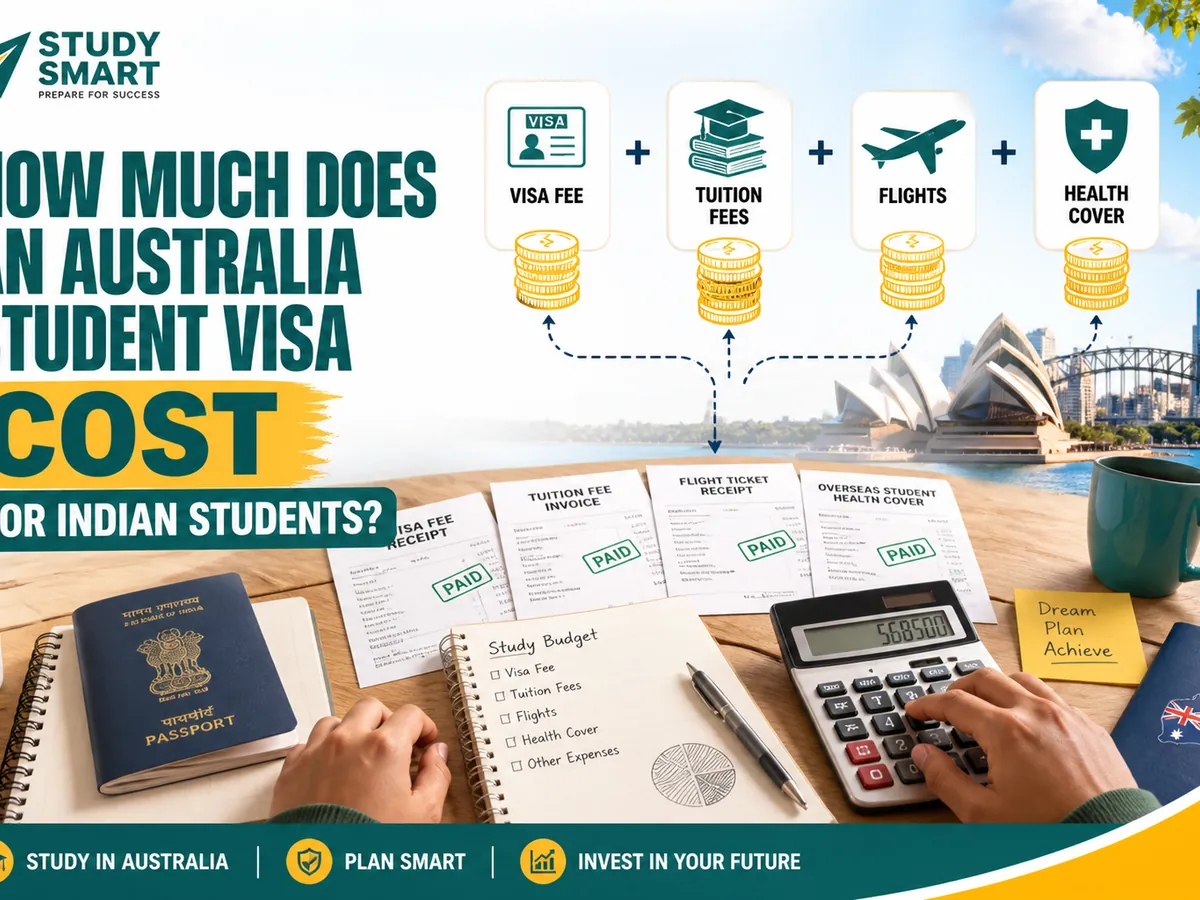
The main student visa (subclass 500) fee is now AUD 2,500, up from AUD 2,000 (The PIE News, 2026). Students coming only for an English language course (ELICOS) pay AUD 2,050 (The PIE News, 2026). The fee is non-refundable, so a refusal means you lose it (ICEF Monitor, 2026).
The visa fee is only one part of your budget. You also need tuition, test fees, medical checks, flights and OSHC. OSHC stands for Overseas Student Health Cover, the health insurance you must hold for the required period (Study Australia, 2026).
Think about life after graduation too. The Temporary Graduate visa (subclass 485), Australia's post-study work visa, rose to AUD 5,750 on 1 July 2026 (Study Australia, 2026).
In most cases, no. Since 2 October 2026, you cannot include family members in a first or further student visa application unless an exemption applies (Study Australia, 2026). You also cannot add family after your visa is granted, and that rule has no exemptions.
The main exemptions cover:
These exemptions are listed by Study Australia (Study Australia, 2026). For married Indian professionals planning a master's, this is a big shift. If your spouse must come with you, a PhD or a separate visa route may be the only option. Similar family limits are also planned for the 485 graduate visa, with no date given yet (Study Australia, 2026).
Mostly no. Since 2 October 2026, most temporary visa holders, including Working Holiday Maker holders, cannot apply for a student visa while in Australia (Study Australia, 2026). Most current student visa holders also cannot apply for another one onshore. If you apply from outside Australia, you must also be outside Australia when the visa is granted.
A few exemptions remain. Examples include moving up to a higher-level course after finishing your main course, or needing up to 12 more months with the same provider (Study Australia, 2026). A new Transfer stream is also planned for students who change providers, but its details are not final yet.
The lesson for Indian students is simple. Choose your course and university carefully at the start, because changing your plan later is now much harder.
Not right now. The government has opened a consultation on a new way for students to prove they can pay their costs. Three of the four options would require you to hold funds in an Australian account in your own name before applying (ICEF Monitor, 2026). No final decision has been made.
The fourth option is a controlled pathway for recognised education finance. That option could matter for families who rely on student loans from Indian banks (ICEF Monitor, 2026). The Association of Australian Education Representatives in India (AAERI) called the first two options impractical. AAERI also raised worries about currency risk and a proposed 50% requirement measured against the full course cost (ICEF Monitor, 2026).
Until the rules actually change, follow the current Department of Home Affairs requirements. Do not move money abroad based on a proposal.
The Genuine Student (GS) requirement checks whether you truly plan to study in Australia. You answer questions about your background, your course choice and how the course fits your career. The government plans to revise Ministerial Direction 106, the guidance officers use for this check, to make expectations clearer and more predictable (ICEF Monitor, 2026).
Until the new guidance comes out, the current approach applies. Strong GS answers are specific. They name the course subjects that matter to you, explain why Australia suits your goals better than other options, and link the degree to real jobs. Generic answers copied from websites are easy for officers to spot.
If you are planning an Australia student visa in Pune or Delhi for a 2027 intake, the rules reward early and careful preparation. The example below is illustrative, not a real client, but it shows how the steps fit together.
Priya is a final-year engineering student from Kothrud, Pune. She wants a master's in data science at Monash University in Melbourne. Her father runs a small business and will sponsor her, and an education loan will cover part of the cost. Here is how she should plan:
A family in Delhi NCR would follow the same steps. The main difference is the type of paperwork, such as salary slips for salaried parents versus business records for self-employed ones.
Study Smart's student visa documentation team helps families prepare complete, consistent files for EL3 checks. If you want to rehearse your answers, our visa interview preparation sessions cover the questions students usually face.
The checks are stricter, yes. India has been at Evidence Level 3 since 8 January 2026, so you need fuller proof of funds, English and academic history (The Indian Sun, 2026). Genuine students with complete, consistent files can still be granted visas.
The subclass 500 student visa fee is AUD 2,500 (The PIE News, 2026). The fee is non-refundable, so check every document before you apply.
Since 2 October 2026, most applicants cannot include family members (Study Australia, 2026). PhD students, some scholarship holders and DFAT or Defence sponsored students are exempt.
You can work up to 48 hours per fortnight while your course is in session (Study Australia, 2026). Plan your budget so you do not depend on part-time work to pay tuition.
Not under the current rules. Holding funds in an Australian account is only a proposal under consultation, and no decision has been made (ICEF Monitor, 2026).
Ready to plan your 2027 intake? Book a free consultation with Study Smart at our Pune or Delhi centre and get a clear checklist for your Australian student visa file.




-1766748863.jpg)

























 (4)-1792570898.png)