-1751978393.webp)
If you are an Indian student planning a US degree for 2027, a blocked DHS rule could still change how long you may stay. The F-1 visa four-year rule would end open-ended stays for international students in the United States and give each student a fixed end date instead. The Department of Homeland Security (DHS) finalized the rule in July 2026, but a federal judge blocked it one day before it was due to start.
For Indian students planning a US degree for 2027 or 2028, the rule is paused, not cancelled. This guide explains where things stand in mid-November 2026, what would change if the rule returns, and how to plan without panic.
At a glance
The four-year rule is a DHS regulation that replaces open-ended "duration of status" with a fixed end date on each student's arrival record. A student would be admitted until the program end date on the Form I-20, capped at four years, plus 30 days. Staying longer would require a formal extension request.
You need three terms to follow the rest of this guide. The Form I-20 is the document your US university issues to show your program and its expected end date. The I-94 is your electronic arrival record, which tells US officials how long you may stay.
Duration of status (D/S) is the special marking F-1 students have long received on the I-94. D/S means you can stay as long as you remain a full-time student in good standing, with no fixed calendar date. Under the rule, D/S would be replaced by an "Admit Until Date" printed on the I-94.
DHS published the final rule in the Federal Register in July 2026 (Federal Register, 2026). One detail many news stories miss: the four-year cap limits a single admission period, not your total time in F-1 status (Yale OISS, 2026). With an approved extension, or by travelling and re-entering, a student could still finish a longer degree.
No. As of mid-November 2026, the rule is blocked. Judge F. Dennis Saylor IV of the US District Court for the District of Massachusetts postponed it on September 14, 2026, and barred DHS from implementing it. F-1 students are still admitted for duration of status and keep the 60-day grace period.
A federal judge blocked the four-year rule with a preliminary order on September 14, 2026, one day before it was due to take effect (Jeelani Law, 2026).
The judge found that the challengers, a group of higher education organizations, were likely to win their claim that DHS broke the Administrative Procedure Act. That is the US law that controls how federal agencies make rules (Jeelani Law, 2026). The order is preliminary, which means the court has not given its final ruling.
Last updated: November 14, 2026. On November 3, 2026, DHS asked the First Circuit to pause its appeal for 30 days while the district court works toward a final ruling (International Legal and Business Services Group, 2026). Before that request, a November 1, 2026 status tracker listed three things still moving (F1Jobs, 2026):
The same tracker warns that some government web pages, including the online text of the federal regulations, still read as if the rule took effect on September 15. USCIS has stated on its Form I-539 page that it will proceed under the previous rules while the court order stands (F1Jobs, 2026). If you see conflicting information online, ask your university's international office.
If the F-1 duration of status rule returns, students would get a fixed end date, a shorter grace period and tighter limits on changing course. Extra time would need a USCIS application filed before the I-94 date expires. Overstaying that date could start counting unlawful presence automatically.
Here is what the final rule would change, based on Yale's summary of the regulation (Yale OISS, 2026):
The biggest risk sits outside this list: unlawful presence. Under the new system, unlawful presence could start counting automatically the day after your Admit Until Date passes. More than 180 days of unlawful presence can trigger a three-year bar on returning to the US, and one year or more can trigger a ten-year bar (Yale OISS, 2026).
The rule would also offer some protection to current students. Students admitted on D/S before the rule starts would keep D/S until their program or work permit ends, up to an outer limit of November 14, 2030. This date is based on the original September 15, 2026 start date and could change if the rule takes effect later. Travelling abroad and re-entering after the start date, however, would end that protection.
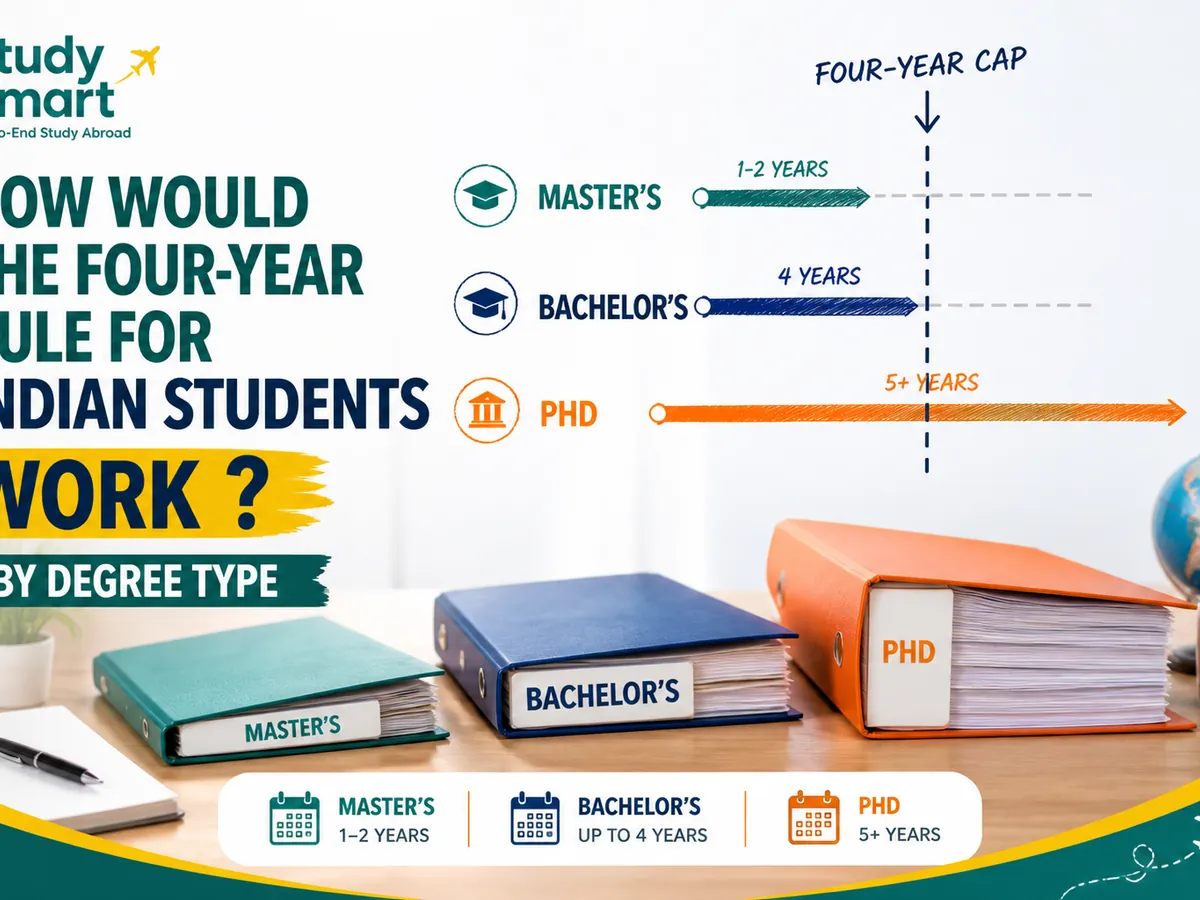
The four-year rule for Indian students would hit hardest where programs run long or plans change. A standard two-year master's fits easily. A four-year bachelor's fits with no room to spare. PhD students would almost always need at least one extension or a fresh admission after travel.
The examples below are illustrative. The dates are our own sample timelines, applied to the rule as Yale describes it (Yale OISS, 2026).
Priya from Pune joins an MS in Data Science with an I-20 running from August 2027 to May 2029. Her Admit Until Date would be about 30 days after her program end date, well inside the cap. Her real pressure point is OPT: post-completion work usually runs past the Admit Until Date, so a student who entered after the rule started would generally need to file both Form I-765 (the OPT work permit application) and Form I-539.
Arjun from Delhi starts a BS in Computer Engineering with an I-20 from August 2027 to May 2031. The program fits the four-year cap exactly. If he fails a course and needs one more semester, he would have to request an extension and pay the fee. He also could not switch majors during his first academic year without SEVP approval.
A five or six-year doctorate cannot fit inside a single four-year admission. A PhD student would need an approved I-539 extension or a new admission after travelling home and re-entering. Each extension adds paperwork, a fee and waiting time.
At a glance
The US student visa four-year limit would not cancel OPT or STEM OPT. Optional Practical Training (OPT) is the work permit F-1 students use after graduation, and STEM OPT is its extension for science and technology graduates. Because OPT often runs past the Admit Until Date, many students would need an extension filing too.
Yale's summary notes that, under the original timeline, students admitted on D/S before the start date who filed Form I-765 (the OPT application) on or before March 18, 2027 would not need a separate extension (Yale OISS, 2026). That deadline may move if the rule returns. Students who travel after the start date and then apply for OPT would generally need both forms.
Today, with the rule blocked, OPT works as before. The 30-day grace period you may have read about came from the blocked rule. The real F-1 grace period remains 60 days, and OPT unemployment limits remain 90 days, or 150 days with STEM OPT (F1Jobs, 2026).
Keep one separate proposal on your radar. In October 2026, DHS proposed that schools pay a fee before recommending students for OPT (F1Jobs, 2026). That fee is only a proposal and is not part of the four-year rule.
India sends more students to the US than any other country, and many of them rely on OPT after graduation. Any change to how long students may stay, or to post-study work, therefore lands hardest on Indian families who have planned and borrowed for a US degree.
There were 363,019 Indian students in the US in 2024/25, up 10% from the year before, which kept India as the top sending country (IIE Open Doors, 2025). The same report counted 294,253 international students on OPT, a 21% increase (IIE Open Doors, 2025).
For a family in Kothrud or Dwarka funding a degree with an education loan, the rule is less about visas and more about time and money. An extra semester, an extension fee or a refused extension can change the return on a degree that was budgeted to the month.
You do not need to drop a US plan because of a rule that is currently blocked. You do need to build a plan that still works if the rule returns in 2027 or later. These steps hold up whichever way the court case goes.
No. The rule was postponed by a federal court on September 14, 2026, but it has not been struck down for good. DHS has appealed, and the district court has not yet issued its final decision.
Yes. The four-year cap applies to each admission period, not to your total time in F-1 status. You would need to file Form I-539 for an extension, or receive a new admission after travelling and re-entering.
Not right now. While the court order stands, F-1 students keep the 60-day grace period. The grace period would drop to 30 days only if the rule takes effect.
No. The rule changes how long you are admitted once you arrive, not who qualifies for an F-1 visa. You should still be able to explain your program dates and funding clearly at your interview.
Court cases move slowly, but admission deadlines do not. Study Smart's counsellors in Pune and Delhi help Indian students choose programs that fit the timeline, prepare financial papers that match the I-20, and file clean visa applications. Book a session with our counsellors to build a US plan that holds up whichever way the four-year rule goes, and see how our student visa documentation experts support your application.




-1766748863.jpg)




























 (4)-1792570898.png)