-1751978393.webp)

Artificial intelligence has moved from a niche specialization to a core hiring priority across industries, and universities abroad have responded with a wave of new master's programs for the 2027 intake. For Indian students, the real challenge is no longer finding an AI program but choosing the right one from hundreds of options that differ sharply in cost, research depth, and career payoff.
This guide breaks down the strongest AI and emerging-tech master's courses abroad for 2027, the countries offering the best return on investment, and the admission steps you should begin now.
An AI master's abroad is worth it in 2027 because employer demand for these skills is expanding faster than the global supply of qualified graduates. The World Economic Forum identifies AI and big data specialists among the fastest-growing roles through 2030, and universities have scaled programs accordingly (WEF, Future of Jobs Report, 2025).
"Analytical thinking remains the most sought-after core skill among employers." (World Economic Forum, Future of Jobs Report, 2025)
For Indian students, the compensation differential remains a decisive factor, since machine learning roles in the US, Germany, and the Netherlands typically command starting packages well above comparable Indian positions. Hiring momentum is also supported by sustained corporate investment in AI infrastructure, which the Stanford Institute for Human-Centered AI documents in its annual tracking of the field (Stanford AI Index Report, 2025).
The 2027 intake is strategically well-timed for a second reason. Regulatory frameworks such as the European Union's AI Act, which entered into force in August 2024, are creating entirely new roles in AI governance, compliance, and risk assessment (European Commission, 2024). Graduates who combine technical training with an understanding of regulation will be positioned for jobs that barely existed five years ago.
The strongest specializations for 2027 are artificial intelligence and machine learning, data science and business analytics, robotics and autonomous systems, cybersecurity, and human-computer interaction with AI ethics. Each maps to a distinct career path, so choose based on the job you want rather than the trend of the moment.
Artificial intelligence and machine learning. This is the flagship option, covering deep learning (neural networks that learn patterns from large datasets), natural language processing (teaching machines to interpret human language), and computer vision. Graduates typically move into ML engineer, applied scientist, and research roles across technology, finance, and healthcare.
Data science and business analytics. These programs suit students who want to combine statistics with commercial decision-making, and they often sit between engineering and management schools. Employment of data scientists in the US is projected to grow 36 percent between 2023 and 2033, far faster than the average for all occupations (US Bureau of Labor Statistics, 2024).
Robotics and autonomous systems. This specialization blends mechanical systems, control theory, and AI, and it feeds demand in automotive, manufacturing, logistics, and drone technology. Germany, Japan, and the US host the most established programs and industry partnerships in this space.
Cybersecurity and information assurance. Modern security curricula now include adversarial machine learning, which is the study of techniques designed to deceive AI models, alongside AI governance and secure system design. Employability is high across virtually every market because security talent shortages predate the current AI wave.
Human-computer interaction and AI ethics. These interdisciplinary degrees prepare students for responsible AI, policy, and product design roles. The field is smaller than the others, but regulatory demand in the EU and the UK is expanding it steadily (European Commission, 2024).
Consider a student from a tier-2 engineering college in Pune with a computer science degree, a 7.5 CGPA, and one year of experience as a data analyst. Instead of chasing only brand-name US programs, she shortlists a German technical university for machine learning (near-zero tuition), an Irish university for data science (one-year program with a two-year post-study stay-back option), and a Canadian university with a funded research stream. Her mixed shortlist balances cost, visa certainty, and career goals, which is exactly the structure we recommend for the 2027 intake. This example is illustrative, based on typical applicant profiles we counsel in our Pune and Delhi centres, and not a specific admissions case.
 ## Which countries are best for an AI master's in 2027?
The USA, Germany, Canada, Ireland, the UK, and Australia are the leading destinations for AI and emerging-tech master's programs in 2027. The USA dominates research output and funding, while Germany and Ireland stand out for affordability and post-study work rights. Your best country depends on budget, specialization, and visa priorities.
At a glance
If budget is the primary constraint, Germany and Ireland deliver the strongest value. If research prestige and long-term earning potential matter most, the USA remains the benchmark despite its cost. Our guide to the best countries to study abroad for Indian students compares these destinations across cost, visa rules, and career outcomes in more detail.
Most AI and emerging-tech master's programs require a quantitative bachelor's degree, demonstrable programming ability, proof of English proficiency, and a strong statement of purpose. Top-tier programs may also expect research experience, GRE scores, or prior coursework in linear algebra, probability, and algorithms.
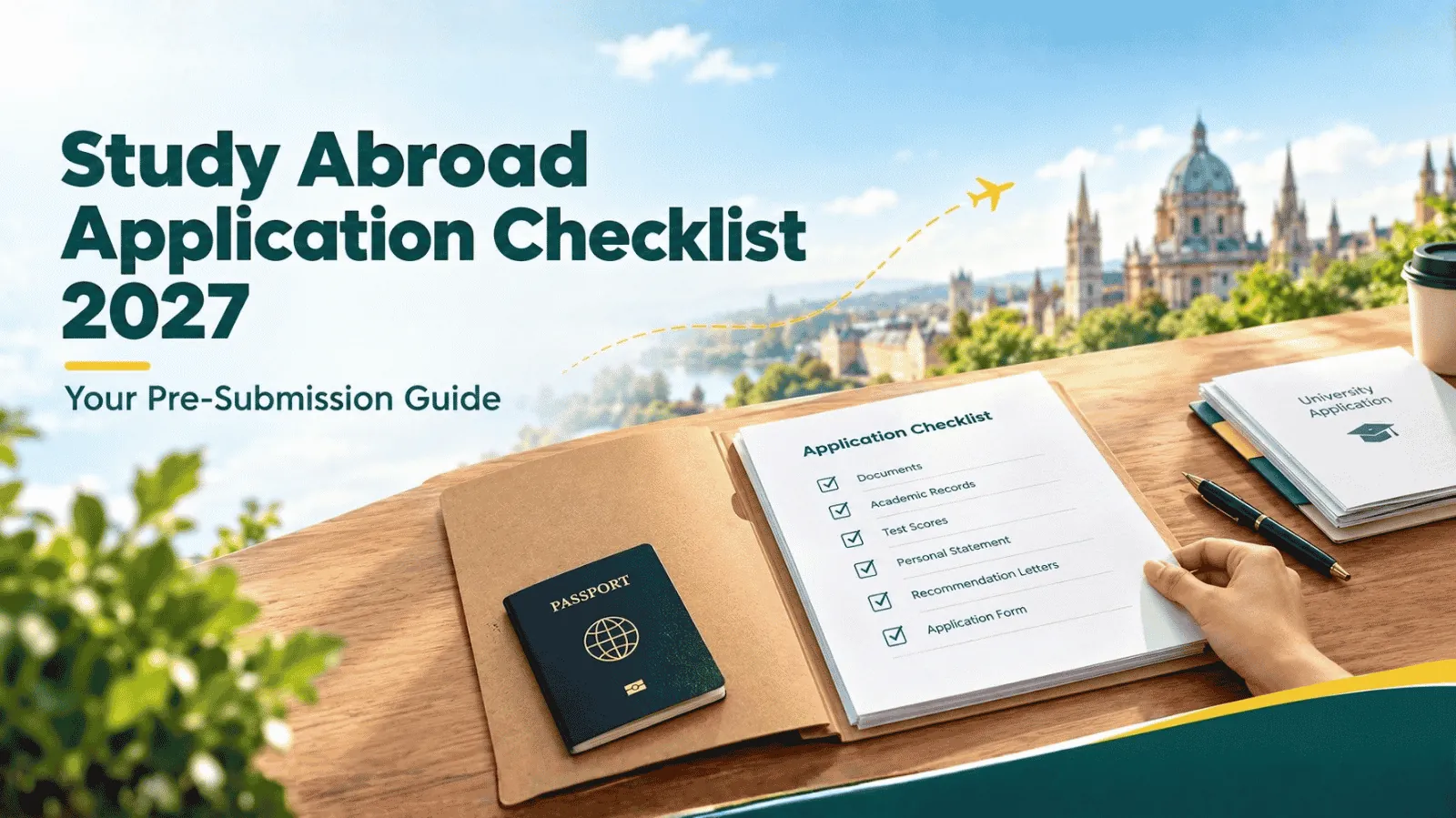
A typical requirements checklist for the 2027 intake looks like this:
Because English test scores carry strict validity windows, schedule your IELTS attempt so the score remains valid through the application cycle. Our IELTS, PTE, and TOEFL test preparation programs are built around the band requirements of top AI programs, with certified trainers and targeted score-improvement strategies.
 ## How much does an AI master's abroad cost, and what scholarships exist?
Total costs for an AI master's abroad range from under EUR 5,000 in total semester fees at German public universities to more than USD 100,000 for a two-year US private program, based on published 2025-26 fee schedules. Scholarships, assistantships, and education loans can offset much of this, but they require early and deliberate planning.
Key funding routes for Indian students include the following:
Parents should budget for living costs separately. The German blocked account requirement, for instance, was EUR 11,904 per year at the time of writing (German Federal Foreign Office, 2024), while UK visa rules require proof of maintenance funds that vary by study location (UK Home Office, 2024).
For a September 2027 start, begin serious preparation by mid-2026, roughly 12 to 15 months ahead. Competitive programs at US and UK universities often close applications between December 2026 and February 2027, and scholarship deadlines frequently fall earlier than admission deadlines.
A practical timeline:
Students targeting Germany should note that winter intake applications through uni-assist often close by mid-July (uni-assist, 2025), which requires an even earlier document pipeline, including the APS certificate now mandatory for Indian applicants to German universities (APS India, 2024).
Graduates of AI and emerging-tech master's programs can expect strong demand in machine learning engineering, data science, applied research, and AI governance roles across technology, finance, healthcare, and manufacturing. The US Bureau of Labor Statistics projects much-faster-than-average growth for computer and information research scientists through 2033 (US BLS, 2024).
Three career trends deserve attention. First, employers increasingly prefer candidates who pair a technical specialization with domain knowledge, such as AI in healthcare or machine learning in supply chains. Second, post-study work visas in Germany, Ireland, Canada, and the UK allow graduates to convert their degree into local experience before deciding whether to settle abroad or return to India. Third, India's own AI sector is scaling quickly, so a foreign master's with two to three years of overseas experience creates strong leverage for senior roles back home.
If you are an Indian student or parent planning the 2027 intake, three actions matter most right now. Shortlist programs across at least two countries so visa or funding setbacks never derail the entire plan, and treat scholarships as a parallel application track with their own deadlines. Book your IELTS or PTE attempt early enough that your score stays valid through the full application cycle, and build a visible portfolio of coding or machine learning projects, because admissions committees at research-driven programs weigh demonstrated skill heavily.
For parents, the financial case deserves the same rigour as the academic one. Compare total cost of attendance against realistic post-study earnings in the destination country, and evaluate post-study work rights as part of the return on investment, not as an afterthought.
Students in Pune, Delhi NCR, and other Indian hubs can get a personalized shortlist, scholarship mapping, and a 2027 intake timeline from our counsellors. Start with our expert study abroad counselling services, which cover everything from test preparation and university admissions to SOP writing and visa clearance under one roof.
Yes, for students with a quantitative background and clear career goals. Employer demand for AI skills continues to outpace supply (World Economic Forum, 2025), and overseas programs offer research depth and post-study work access that are difficult to replicate domestically.
Germany is generally the most affordable option because most public universities charge little or no tuition, only modest semester fees. Ireland and Canada offer mid-range tuition with strong post-study work rights, while the USA is the most expensive but often provides assistantships that offset costs.
Most competitive programs require an IELTS overall band of 6.5 to 7.0, with no individual band below 6.0, according to published university admission pages (2025). Top UK and US departments sometimes ask for 7.0 or higher, so check each program's page before booking your test.
Yes. Options include university merit awards, government schemes such as DAAD for Germany and GREAT Scholarships for the UK, and research assistantships at US and Canadian institutions (respective program websites, 2025). Applying early and to multiple funding sources materially improves your chances.
Ideally, begin 12 to 15 months before your target start date, which means early to mid-2026 for a September 2027 intake. This window allows time for test preparation, portfolio building, applications, scholarship deadlines, and visa processing without last-minute pressure.






























-1750416362-1750417414.jpg)

-1790399182.png)


-1790830806.png)

-1789647708.png)
-1789648196.png)
 (1)-1787123243.png)















-1749620108.png)

















-1789648364.png)
-1789648032.png)
-1789647864.png)

-1789648649.png)



-1790228836.png)