-1751978393.webp)
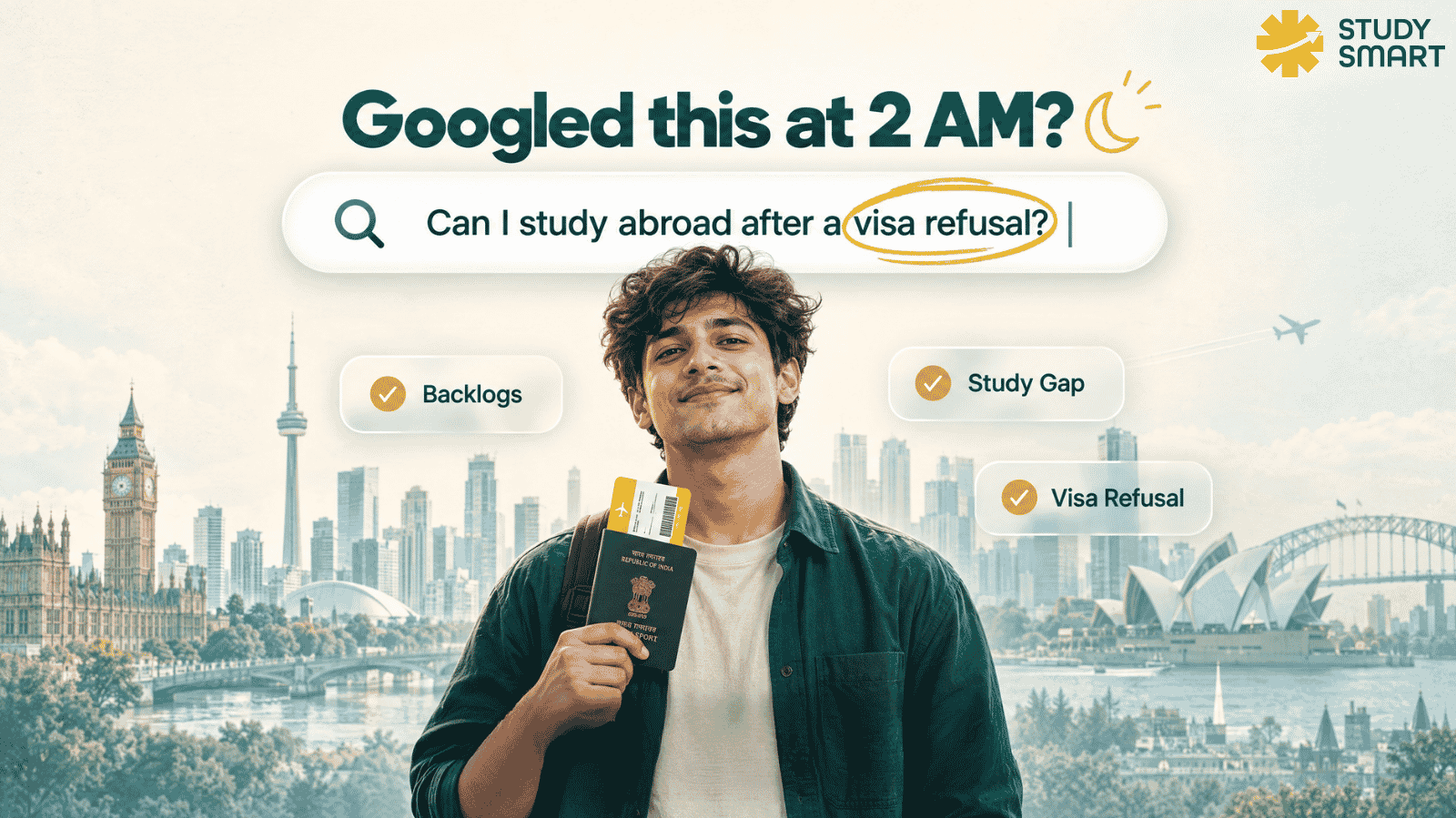
Academic backlogs, employment gaps, low initial language test scores, and visa refusals frequently derail Indian students seeking international education. With strategic documentation and profile repositioning, students can resolve these historical barriers and enter competitive global institutions.
At a glance

## How Can Indian Students Secure Admissions with Academic Backlogs?
Indian students can secure university offers despite historical backlogs by presenting official backlog summary certificates, demonstrating upward grade trajectories, and explaining root causes within their Statement of Purpose. Admissions committees evaluate overall academic readiness rather than isolated past failures when applications provide clear context.
In the Indian higher education system, a backlog represents an exam a student did not clear on the first attempt, requiring a retake in a subsequent term. Foreign universities evaluate these attempts differently. For example, German and Canadian institutions often count total exam attempts, while many universities in the United Kingdom and Australia focus on cleared backlogs and final cumulative scores.
A Pune-based mechanical engineering graduate applied with seven historical backlogs and an overall undergraduate score of 62%. The backlogs occurred during the student's first two years in core mathematics and thermodynamics. However, the student maintained a 76% average across the final four semesters.
The student used the following step-by-step strategy to apply to international universities:
Through this approach, the student received unconditional Master of Science offers from two established universities in the United Kingdom.
Applicants can justify academic gaps by providing documented evidence of full-time employment, freelance engagements, technical certifications, or valid personal circumstances. Transparent continuity documents assure admissions officers and visa authorities that the candidate remained productive throughout the break.
Admissions boards routinely accept multi-year breaks after graduation when candidates show continuous professional development. Unexplained gaps create concerns regarding academic intent, whereas documented work experience strengthens a postgraduate profile.
A commerce graduate from Delhi presented a 36-month gap between completing a Bachelor of Commerce degree and applying for an international Master of Science in Finance. The gap involved preparing for public service examinations followed by independent financial consulting.
The candidate structured the application using three key steps:
This structured documentation resulted in direct admission to a recognized business school in Ireland.
Students can raise their IELTS scores by identifying specific sub-band weaknesses, practicing targeted diagnostic mock exams, and completing structured language coaching. Focused preparation allows test-takers to reach minimum university cutoffs across reading, listening, writing, and speaking modules.
Many competitive postgraduate programs require an overall score of 6.5 to 7.5 on the International English Language Testing System (IELTS), with minimum sub-band requirements of 6.0 or 6.5. Students often struggle with writing coherence and spontaneous speaking fluency during initial attempts.
An applicant seeking admission to an Australian Master of Information Technology program had an initial overall IELTS score of 5.5, with a 5.0 in the writing module. The target institution required an overall 6.5 with no band below 6.0.
The student enrolled in specialized English proficiency test preparation and implemented the following plan:
Within six weeks, the applicant achieved an overall score of 7.0, with a minimum of 6.5 across all four sections, securing admission and meeting visa language criteria.
 How Can Candidates Achieve Visa Approval After Rejection?
Candidates achieve visa approval after rejection by ordering official refusal notes, identifying the exact legislative grounds for the denial, and submitting strong counter-evidence. Reapplications must directly resolve previous weaknesses rather than resubmitting the identical file.
Visa rejections commonly cite insufficient financial ties, lack of home country ties, or vague career progression plans. Immigration departments, such as Immigration, Refugees and Citizenship Canada (IRCC) or the US Department of State, require documented proof that the student intends to complete their program and maintain legal status.
"Comprehensive visa documentation and structured interview preparation remain essential to reversing previous student visa refusals." (Study Smart Case Insights, 2024)
An applicant received a Canadian study permit refusal under Section 216(1)(b) of the Immigration and Refugee Protection Regulations. The visa officer stated that the applicant had not demonstrated sufficient financial resources and had not established clear ties to India.
The remediation strategy included:
The reapplication resulted in a successful visa grant within four weeks of submission.
Families can prevent education loan delays by securing pre-sanction letters early, verifying property titles with legal counsel, and combining liquid deposits with education loans. Timely financial proof ensures students meet university confirmation deadlines and visa filing windows.
Indian nationalized and private banks require rigorous document verification for unsecured and collateral-backed study loans. Delays frequently occur due to property title ambiguities, unmapped ancestral records, or missing co-borrower tax documents.
Successful study abroad applications depend on early planning, realistic university shortlisting, and thorough document management. Students should systematically build their academic and financial profiles at least eight to twelve months before their intended intake.
Careful planning reduces procedural errors and gives applicants enough time to retake tests, request official transcripts, and apply for external scholarships.
If you are an Indian student facing academic backlogs, career breaks, test score hurdles, or previous visa refusals, your international education goals remain attainable. International institutions assess complete profiles, not just isolated examination results.
To build a competitive international application:
For personalized profile evaluation and complete visa guidance, speak with our experienced consultants who specialize in student visa documentation services.
No, academic backlogs do not permanently disqualify applicants. Most universities accept students with backlogs if the subjects have been cleared and the overall grade meets the institution's minimum entry criteria.
Most international universities accept gaps of two to five years or more if the applicant provides verifiable proof of work experience, certifications, or personal reasons. Unexplained gaps create concerns, so documentation is essential.
Yes, students can reapply after a visa rejection by addressing the specific grounds cited by the visa officer. Reapplications that provide new documentary evidence and clearer explanations frequently succeed.
The IELTS Academic exam is accepted by thousands of universities across the UK, US, Canada, Australia, and Europe. Other tests like PTE Academic and TOEFL are also broadly recognized depending on the country and program.
























-1750416362-1750417414.jpg)

-1790399182.png)



-1790830806.png)



-1789647708.png)
-1789648196.png)
 (1)-1787123243.png)












-1749620108.png)


















-1789648364.png)
-1789648032.png)
-1789647864.png)

-1789648649.png)



-1790228836.png)