-1751978393.webp)

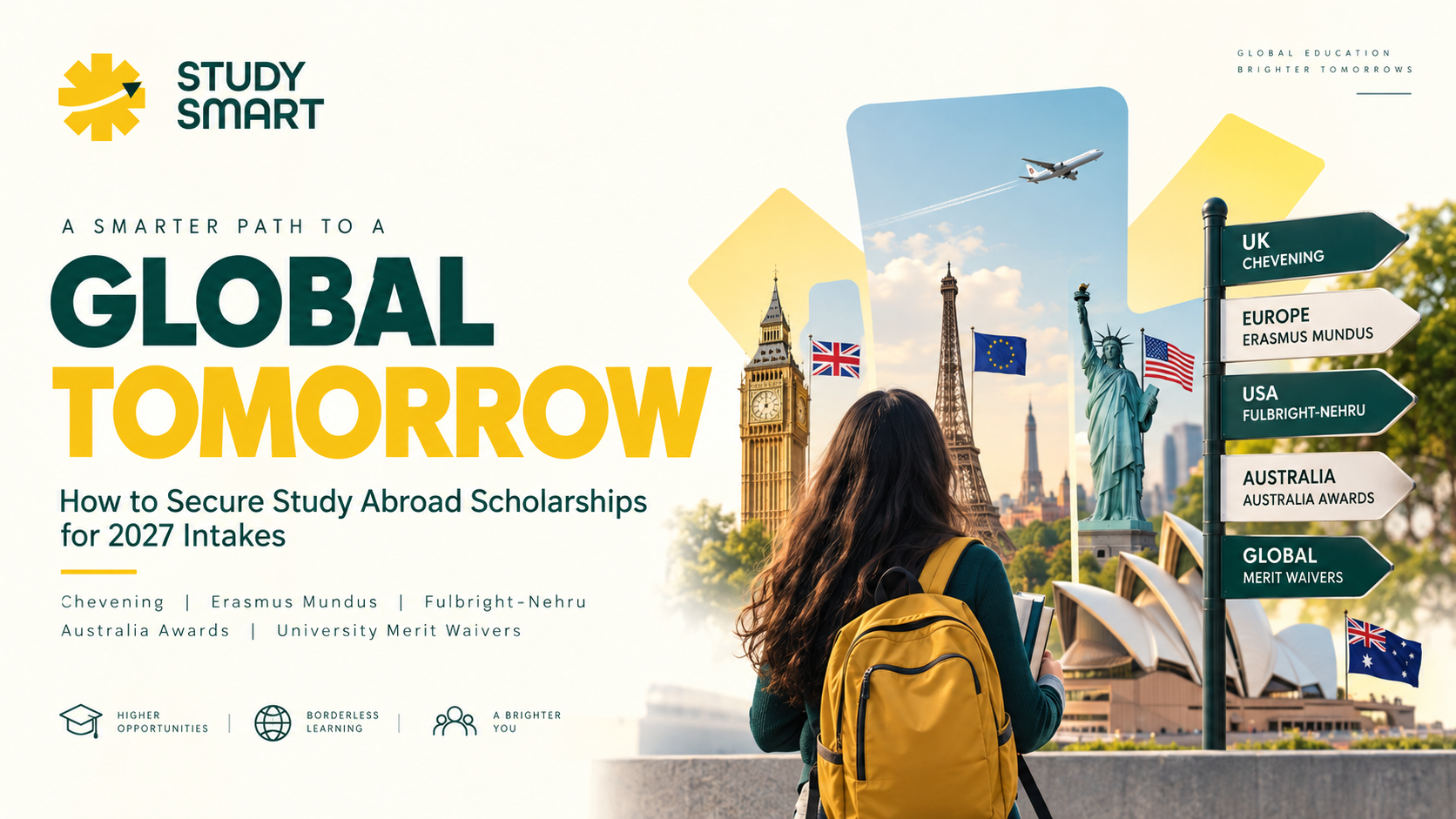
Many Indian students only start looking for funding after they send their university applications in November. By then, some of the biggest awards have already closed. The good news is that plenty of scholarship deadlines for Fall 2027 still fall between December 2026 and March 2027, and students who start now can still meet them.
This guide sorts those deadlines by month and lists the awards that have already closed so you don't waste time on them. It also includes a step-by-step plan that families in Pune and Delhi can follow.
From mid-November 2026, Indian students can still apply for many European programme awards and UK university scholarships, and the at a glance list below gives each date. Indian loan trusts such as J N Tata Endowment and Narotam Sekhsaria have closed in mid-March in past cycles.
The scholarships still open for Fall 2027 fall into three groups: European programme awards, UK university awards and Indian trust funding. Dates below are published for the 2027 cycle unless marked "expected". Indian trusts usually announce fresh dates early in the year, so those entries use the last cycle as a guide.
At a glance
December 2026 is the month for many Erasmus Mundus scholarship rounds, the admission step for Maastricht's top award, Durham's first scholarship round and the last Eiffel steps at French universities. To meet these dates, students need their SOPs, reference letters and English test scores ready before the holidays. Waiting until the New Year usually means missing them.
Erasmus Mundus programmes are master's degrees run jointly by groups of European universities, called consortia. There is no central form or single deadline, and most programmes take applications between October and January (Studentnews.eu, 2026). Scholarship deadlines are often earlier than the deadlines for self-funded students, so check each programme page.
The Erasmus Mundus scholarship is generous. Under the 2026 Erasmus+ call, it pays EUR 1,400 a month, covers travel, visa and settling-in costs, and removes tuition fees (Studentnews.eu, 2026). No more than 10% of a programme's scholarships can go to one nationality, which matters for Indian applicants because the pool from India is large.
Maastricht's NL-High Potential scholarship has a final deadline in February, but the admission step comes first. You must apply to a participating master's programme through Studielink (the Dutch national application portal) and finish your admission file by 10 December 2026 (Scholars4Dev, 2026). Miss that date and you cannot be considered, even if the scholarship form is still open.
Durham University also runs the Inspiring Excellence Postgraduate Scholarship, a tuition discount of £5,000 or £10,000. Its first round closes on 7 December 2026 at 23:59 GMT, with later rounds on 15 March and 1 May 2027 (Durham University, 2026). Applying in an early round gives you more chances, so apply early if Durham is on your list.
The Eiffel scholarship pays master's students EUR 1,200 a month, but students cannot apply directly. Universities choose candidates and send files to Campus France by 6 January 2027, and many internal university deadlines fell between 15 and 30 November 2026 (Dimensions France, 2026). If you are targeting France, email the international office today to ask whether your programme's window is still open.

The main January 2027 scholarship deadlines come from Oxford course deadlines, which decide Clarendon Fund consideration, and from Erasmus Mundus programmes such as Euroculture. Eiffel files also reach Campus France on 6 January 2027. January is the last month to submit university applications for many funded master's places in Europe and the UK.
The Clarendon Fund offers over 200 new scholarships each year to graduate students of any nationality. It covers full course fees and pays a living grant of at least the UKRI minimum doctoral stipend, which is £21,805 for 2026-27 (Scholars4Dev, 2026). There is no separate form: you are considered automatically if you apply for your course by its December 2026 or January 2027 deadline.
This means the real Clarendon deadline is your Oxford course deadline. Check your department page now, because some courses use the December date and others the January date.
The Euroculture MA shows how a typical Erasmus Mundus timeline works. It opened for the 2027-2029 intake on 15 October 2026, its scholarship deadline is 15 January 2027, and results are expected by the end of March 2027 (Studentnews.eu, 2026). Other programmes follow their own calendars, so build a list of the three to five that fit your degree.
February and March 2027 are when most university-specific scholarships for Indian students 2027 close, including the NL Scholarship, Maastricht's NL-High Potential award, Durham's GREAT Scholarship and the Inlaks award at King's. Indian loan trusts have also closed in mid-March in recent cycles. Most of these awards need an admission offer first.
The NL Scholarship is worth EUR 5,000 for one year and is paid in instalments after you arrive in the Netherlands. Its deadline is 1 February, and you need an admission offer from Groningen to apply (University of Groningen, 2026). The page lists the date without a year, so confirm it for 2027 before you plan around it.
The NL-High Potential scholarship covers full tuition, a stipend of EUR 20,150 for a one-year master's, insurance and visa costs. The scholarship form closes on 1 February 2027 at 23:59 CET, and applicants need a GPA of at least 7.5 out of 10 or equivalent (Scholars4Dev, 2026).
Maastricht University awards 18 NL-High Potential scholarships a year, and about 2% of applicants receive one (Scholars4Dev, 2026).
GREAT Scholarships are UK tuition awards funded by the British Council and partner universities for specific countries. Durham offers one £15,000 GREAT award for an Indian passport holder living in India, for a taught postgraduate course in 2027/28 (Durham University, 2026). You must apply for an eligible course by 7 March 2027 and hold an unconditional offer by 18 April 2027.
King's College London works with the Inlaks Shivdasani Foundation to fund Indian citizens doing PhDs in social science, public policy, arts and humanities. The award is worth up to $120,000 per student, and you need a King's PhD offer before you apply (King's College London, 2026). The call opens in mid-February 2027 and closes on 31 March 2027 at 12:00.
Loan scholarships are interest-free or low-cost loans from Indian trusts that students repay after their studies. The J N Tata Endowment offers up to Rs 20 lakh, and its last cycle closed on 15 March (DT Next, 2026). The Narotam Sekhsaria Foundation's postgraduate award is a repayable, interest-free loan that closed on 18 March 2026, and it did not require confirmed admission at the application stage (SAKEC, 2026).
The 2027 dates for both trusts are not out yet, so treat mid-March as an expected deadline. Watch the official trust websites from January onwards.

Chevening, the UK government's flagship award, closed for 2027/28 on 6 October 2026. Many Eiffel internal deadlines at French universities fall between 15 and 30 November 2026, so some may already have passed. The Swedish Institute's global professionals scholarship is open in early 2027, but India is not on its list of eligible countries this cycle.
Chevening applications for 2027-28 are now closed, according to the British Council (British Council Study UK, 2026). If you missed it, the next cycle is the one to plan for, and you can use this year to gain the work experience it values.
The Swedish Institute Scholarship for Global Professionals lists 34 eligible countries for 2027/28, and India is not among them (Scholarship Positions, 2026). Indian students who want Sweden should look at university tuition waivers instead and confirm the latest list on the official Swedish Institute site.
Indian students can meet the remaining deadlines by working backwards from each scholarship date, booking an English test early and applying to universities that unlock the awards they want. The steps below turn the scholarships still open for Fall 2027 into a week-by-week plan.
Here is an illustrative plan for a Pune engineering graduate aiming for a one-year master's in the Netherlands or UK. It is an example of how the dates fit together, not a real case.
If you are applying for Fall 2027, the next 19 weeks matter more than the rest of the year. Most study abroad scholarships for Indian students that are still open need a university application first, so funding and admissions have to be planned together rather than one after the other.
Parents should plan for partial awards, not only full rides. A EUR 5,000 award, a £15,000 tuition cut or an interest-free trust loan can each change the total cost a great deal. Combining one or two of these with an education loan for study abroad is a realistic plan for most families.
Your English score is often the item that holds up everything else. If you have not taken IELTS, PTE or TOEFL yet, start focused test preparation this month so the score is ready for January deadlines.
Study Smart's counselling team in Pune and Delhi helps students match scholarships to their profile, build a timeline and review SOPs before each deadline. The team reports over 12 years of experience and more than USD 6 million in scholarships won by its students. Book a session through our study abroad counselling services to map your own Fall 2027 funding plan.
No. Many scholarship deadlines for Fall 2027 fall between December 2026 and March 2027, including Erasmus Mundus, Clarendon, the NL Scholarship, Maastricht and Durham's GREAT award. Chevening has closed, so focus on university and programme awards.
For many awards, yes. The NL Scholarship and the Inlaks award at King's both need an offer, and Durham's GREAT award needs an unconditional offer by 18 April 2027. Oxford's Clarendon Fund only needs a course application by the deadline.
Not for the 2027/28 Scholarship for Global Professionals, because India is not on its eligible country list. Indian students interested in Sweden should check university tuition waivers instead.
A loan scholarship is money from a trust that you repay after your studies, usually with little or no interest. The J N Tata Endowment and Narotam Sekhsaria Foundation are two well-known examples for Indian students, and both closed in mid-March in their last cycle.

















































-1750416362-1750417414.jpg)







 (6)-1792571238.png)





-1789647708.png)
-1789648196.png)
 (1)-1787123243.png)
















-1749620108.png)

















-1791613809.jpg)

-1790399182.png)




-1790830806.png)
-1789648364.png)
-1789648032.png)
-1789647864.png)

-1789648649.png)



-1790228836.png)