-1751978393.webp)

Most Indian families budget for tuition and forget everything else. Visa proof of funds, tax collected at source, loan interest and a rupee that rarely stays still can push the final bill well above the fee on the offer letter. The tips for study abroad in this guide put official figures on those hidden costs, so you can plan a degree abroad that your family can actually afford.
At a glance
The real cost of studying abroad has four parts: tuition, living costs, one-time setup costs and money costs such as loan interest, tax collected at source and currency conversion. Visa rules are the clearest starting point for living costs, because each government publishes the minimum amount it expects a student to hold.
Here is how the four parts break down:
The UK living cost requirement is £1,529 a month in London and £1,171 a month elsewhere, for up to nine months (GOV.UK, 2026). UK applicants must also show the course fee for the first academic year, as stated on the CAS (Confirmation of Acceptance for Studies), the reference number your university issues.
The UK also checks how long the money has been in your account. Funds must be held for at least 28 days in a row, ending within 31 days of the visa application (GOV.UK, 2026). Moving money into the account too late can break the 28-day rule and lead to a refusal, so move funds well in advance.
Canada requires CAD 23,448 a year for a single applicant outside Quebec, and this figure does not include tuition or travel (IRCC, 2026). If you plan to study in the USA, there is no single national figure. Each university lists its own estimated cost of attendance on the I-20, the form you carry to your visa interview, and you must show funds to match it.
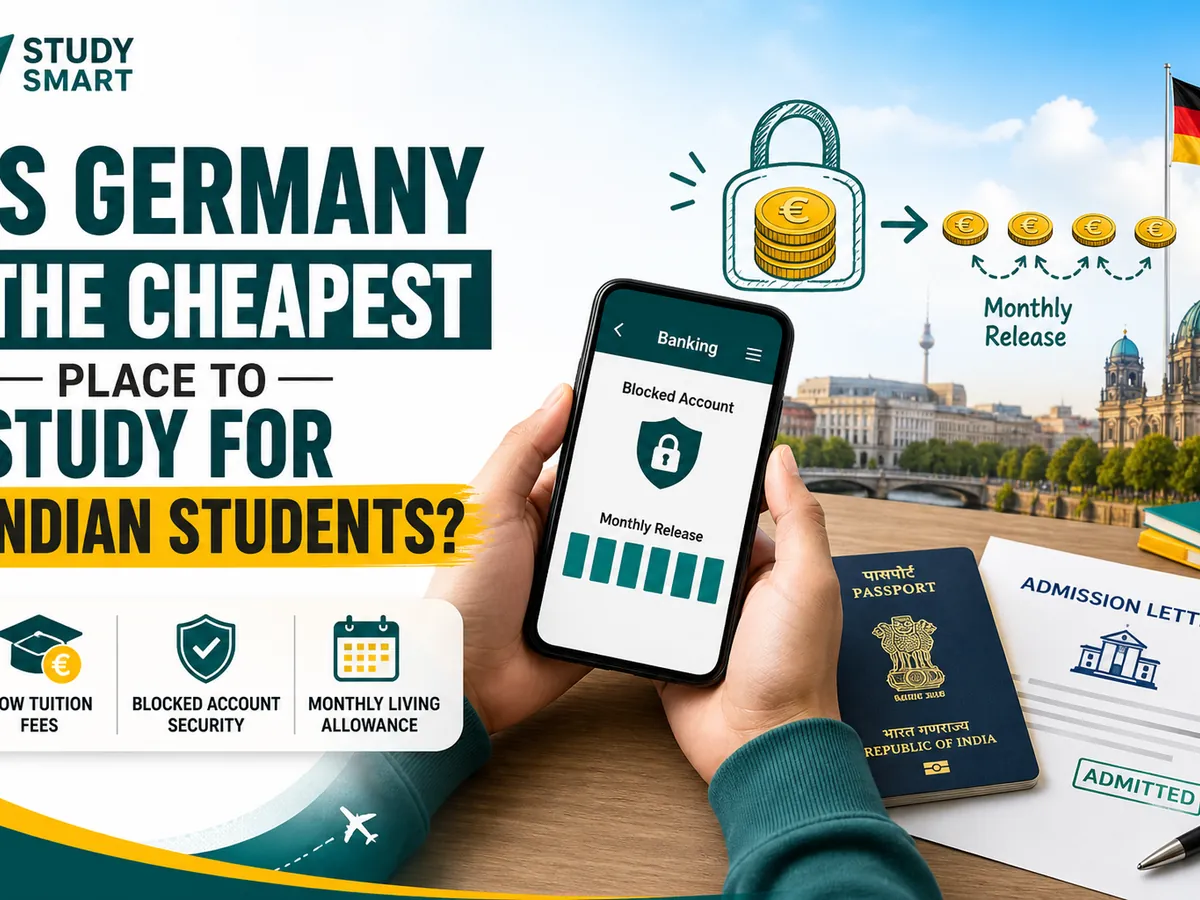
Germany is one of the lowest-cost options for Indian students because most public universities charge no tuition for bachelor's courses or most master's courses. The main cost is living expenses. The German visa system sets a fixed monthly amount that students usually keep in a special bank account called a blocked account.
Non-EU students heading to Germany must prove they have €992 a month at their disposal, even when their public university charges no tuition (DAAD, 2025).
A blocked account is a German bank account where you deposit a full year of living money before you apply for your visa. After you arrive, the bank releases one monthly amount at a time, so the money cannot all be spent in the first term.
Germany still has exceptions worth knowing before you choose a state. Baden-Württemberg charges non-EU students €1,500 per semester, and Bavarian universities may charge international students fees of several thousand euros per semester (DAAD, 2025).
Every student also pays a semester contribution, which covers student services and often a local transport ticket. DAAD puts this contribution at between €70 and €430 per semester (DAAD, 2025). If you want to study in Germany, also budget for German language classes, since many part-time jobs and daily tasks are easier with basic German.
A safe monthly budget starts at the visa minimum for your destination and then adds a buffer for your city, your first month and currency movement. The visa figure proves you can survive. The buffer is what keeps a student from calling home for emergency money in the middle of the first term.
The visa minimum works as a floor for the cost of studying abroad per month:
The first month usually costs more than any later month. Students pay a rent deposit, buy bedding and kitchen items, set up a local SIM and often pay for temporary housing while they look for a flat. Our counsellors suggest building that setup cost into the loan amount or the family's savings plan rather than hoping a part-time job will cover it. (This is guidance from our counselling experience, not an official figure.)
An education loan for study abroad covers tuition and often living costs, with repayment usually starting after the course ends. Indian lenders broadly offer two types: secured loans backed by property or deposits, and unsecured loans based on the student's admission and the co-applicant's income.
A few terms are worth knowing before you compare offers:
When you compare lenders, look at the total cost of the loan and not just the headline interest rate. Ask about processing fees, insurance add-ons, whether interest during the moratorium is simple or compounded, and whether the lender pays the university directly.
Study Smart helps families with this step, from eligibility checks and document preparation to following up on sanction letters with banking partners. Students such as Jay Patel, who took a loan for his studies in Canada, say the team helped them compare lenders and draft their financial documents.

Yes. Indian taxpayers can deduct the full interest paid on an education loan under Section 80E, with no upper limit, for up to eight years or until the interest is paid off, whichever comes first (Oquilia, 2026). The deduction covers interest only, not the principal.
The Income Tax Department lists Section 80E only under the old tax regime (Income Tax Department, 2026). That means the parent or student who claims the deduction must choose the old regime when filing. The loan must come from a bank, a notified financial institution or an approved charitable institution, so loans from friends, relatives or employers do not qualify (Oquilia, 2026).
The Income-tax Act, 2025 replaced the 1961 Act from 1 April 2026, and the 80E deduction now sits under a new section number. Ask your chartered accountant to confirm the exact reference before you file. The idea stays the same: keep the lender's interest certificate every year, because that certificate is your proof for the claim.
TCS, or tax collected at source, is tax your bank collects when you send money abroad under the Liberalised Remittance Scheme (LRS), the RBI framework for personal foreign transfers. For education, the source of the money decides the rate. Loan-funded fees attract no TCS, while self-funded payments above a set limit attract a small percentage.
Here is how the rules now apply:
TCS is not a lost fee. The amount collected appears against the remitter's PAN and can be adjusted against income tax or claimed as a refund when filing the return. TCS still blocks cash for months, though, so mark every transfer as education with the correct purpose code. For loan-funded payments, keep the sanction letter ready for the bank.
You cannot control the exchange rate, but you can control when and how you convert money. The safest approach is to fix the big payments early, spread the rest over time and keep a buffer in the family budget for the months when the rupee weakens.
Follow these steps:
Rupee planning also affects loan size. If your loan is in rupees but your expenses are in pounds, dollars or euros, ask the lender whether the sanctioned amount can be increased later if the currency moves against you.
The most useful budget tips for study abroad are to pick the right city, win scholarships early, get your test scores in one attempt and track every expense from the first week. Small choices made before departure often save more money than cutting back after arrival.
These study abroad tips for Indian students come up again and again in our counselling sessions:
For families in Pune, Delhi NCR and other Indian cities, the biggest savings come from planning the money side as carefully as the application. Here is a concrete example using only the official figures above.
A student from Kothrud is choosing between a UK master's outside London and a public university in Germany. The UK visa minimum for living costs is £1,171 a month for up to nine months, which is about £10,539, plus the first year of tuition on the CAS (GOV.UK, 2026). The German route usually has no tuition at most public universities, but the blocked account needs €992 a month, or about €11,904 for a year (DAAD, 2025).
Course length changes the picture. A UK master's usually lasts one year, while a German master's usually lasts two, so the German living cost for the full course is about €23,808 (2 x €11,904). At market rates on 14 November 2026 (about ₹124.5 to the pound and about ₹104 to the euro), the UK living cost works out to roughly ₹13.1 lakh plus the UK tuition fee on your offer letter.
The German living cost comes to roughly ₹24.8 lakh, with no tuition at most public universities. So the German route is cheaper only if one year of UK tuition costs more than the gap of about ₹11.7 lakh (roughly £9,400). A free-tuition country is not automatically the cheapest once course length is counted. The right answer depends on the course, the career plan and how the family can fund it.
A practical plan for students and parents:
If you would like help with that plan, our study abroad consultants in Pune and Delhi can walk your family through admissions, scholarships, loan paperwork and visa files in one place. Book a free counselling session with Study Smart to build a budget that fits your goals.
You need the first year of course fees shown on your CAS, plus living costs of £1,529 a month in London or £1,171 a month elsewhere, for up to nine months (GOV.UK, 2026). The money must be held for at least 28 days in a row before you apply.
No. Fees paid abroad from an education loan taken from a recognised financial institution attract no TCS (Business Standard, 2025). Keep your sanction letter ready, because the bank will ask for proof that the transfer is loan-funded.
Yes, a parent can claim the deduction if the parent is the borrower and the loan is for the child's higher education. The claim is available only under the old tax regime and covers interest, not principal (Oquilia, 2026).
Tuition at most public universities is free for bachelor's and most master's courses, but living costs are not. Students must prove €992 a month in funds, and Baden-Württemberg charges non-EU students €1,500 per semester (DAAD, 2025).





















































-1750416362-1750417414.jpg)







 (6)-1792571238.png)





-1789647708.png)
-1789648196.png)
 (1)-1787123243.png)




















-1749620108.png)


















-1791613809.jpg)

-1790399182.png)




-1790830806.png)
-1789648364.png)
-1789648032.png)
-1789647864.png)

-1789648649.png)




-1790228836.png)