-1751978393.webp)
Most Indian students who miss a Fall 2027 admit will not lose out because of a weak profile. They will lose out because they started about six months too late. Applications for Fall 2027 master's programs are expected to open as early as August 2026, based on prior admission cycles, so the preparation clock has already started.
This roadmap breaks the next 18 to 24 months into clear phases. It covers profile evaluation, English testing, university shortlisting, SOP writing, budgeting, and visa filing. It also factors in the post-study work rules that are in force right now.
At a glance
You should start 18 to 24 months before your intake. For a September 2027 start, that means early 2026. Study Smart's counselling guidance recommends starting country and university selection at least 12 to 18 months before the start date (Study Smart, 2025). Competitive applicants usually go beyond that minimum.
Many applicants treat the application deadline as the starting gun. In practice, the deadline is the finish line of a much longer race. Universities in the US, UK, and Canada have historically opened fall intake applications between August and December of the previous year (inferred from prior admission cycles). Early rounds usually offer fuller scholarship pools and more open seats.
A longer runway also protects your plan from policy shifts. Destination governments have changed visa rules, fund requirements, and work rights several times in recent years. If one country tightens its rules mid-cycle, an early starter can shift applications to a friendlier destination.
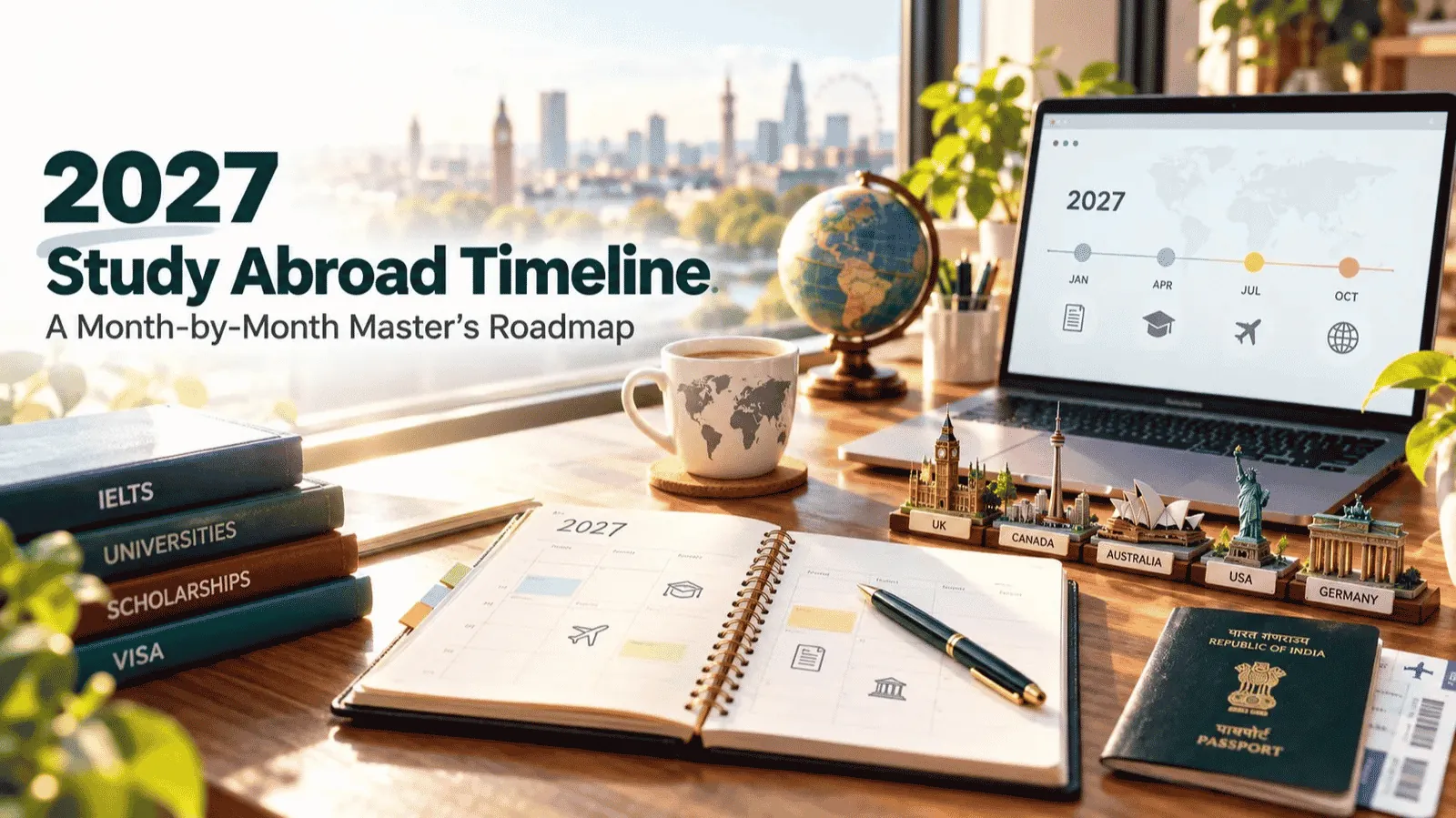
The 2027 study abroad timeline runs in six phases, from January 2026 to September 2027. Each phase builds on the one before it. A delay in one stage squeezes every window that follows, so treat each phase as a hard checkpoint.
Here is the full masters abroad roadmap for 2027, month by month:
Profile evaluation means scoring your academic record, test readiness, work experience, and activities against what target programs expect. Do this between January and March 2026. That timing leaves you a full year to fix any gaps before applications open.
A concrete example helps here. Consider an engineering graduate from Pune with a 6.8 CGPA who wants a data science master's in Germany. A profile review in February 2026 might flag two gaps: no research exposure and no industry project. By June 2026, that student can finish a machine learning certification and a three-month analytics internship. Both additions directly raise admission odds.
Common gaps worth checking include a low CGPA in core subjects, no internships, weak coding or quantitative skills, and a thin final-year project. Admissions committees read profiles as a whole. One strong, relevant addition often matters more than five unrelated certificates.
Take IELTS or PTE between April and July 2026. Both tests produce scores that stay valid for two years (IELTS Partners, 2025; Pearson, 2025). A mid-2026 score card stays valid through the application season and through visa filing in 2027.
This window gives you three practical advantages. First, you get your score before shortlisting, so you only apply to programs whose cutoffs you meet. Second, you keep June or July free for a retake without any panic. Third, you free up the busy August to October period for essays and applications.
Most students need 8 to 12 weeks of focused preparation for IELTS or PTE. If your English base is weaker, start in January 2026. Structured coaching helps most first-time test takers, and Study Smart runs dedicated IELTS and PTE training programs in both classroom and online formats.
If your target schools need the GRE or GMAT, schedule those for May or June 2026. Keep the two test types at least a month apart. Trying to prepare for both at once is the most common timing mistake applicants make.
Use a three-tier shortlist of 8 to 12 universities: two or three dream schools, four to six target schools, and two or three safe schools. Judge each program on curriculum, total cost, work rights after graduation, and career outcomes. Rankings alone are a poor filter.
Here is a simple framework that works well:
Destination mix matters as much as tier mix. The Big Four destinations, the US, UK, Canada, and Australia, are losing ground as the default choice for Indian students. Combined enrollments across these four are forecast to decline an average of 0.5% a year through 2030, with Germany, France, and the UAE gaining share (LeapScholar, 2026).
"New international enrollments at US universities dropped 17% in 2026, driven partly by a decline in Indian postgraduate enrollments (QS data via LeapScholar, 2026)."
The practical lesson is simple. Keep one or two applications outside the Big Four. Germany charges little or no tuition at public universities, and Ireland offers a two-year post-study stay for master's graduates. If you are unsure how to weigh countries against each other, Study Smart's counsellors can help you compare the best countries to study abroad for Indian students based on your profile and budget.
Start your SOP in August 2026 and plan for three drafts over six to eight weeks. A strong SOP answers three questions: why this field, why this program, and why you. Generic essays that praise the university's ranking rarely survive the first read.
A workable drafting schedule looks like this:
For LORs, ask your recommenders at least two months before your first deadline. Share your resume, your draft SOP, and a short list of projects they supervised. Most recommenders are busy, and a rushed letter reads exactly like a rushed letter.
Budget for the full cost of attendance: tuition, living costs, insurance, visa fees, travel, and an emergency buffer. For Indian students, total costs for a master's abroad run roughly from Rs 25 lakh to Rs 70 lakh depending on country and program (approximate published ranges, 2025). Post-study work rules decide how fast you recover that spend.
Here is where work rights stand in the major destinations:
Build your budget in three lines. Line one is fixed costs you must pay before departure, such as deposits and visa fees. Line two is annual tuition and living costs. Line three is your recovery plan, meaning expected earnings during the post-study work period. An education loan with a moratorium, a period where repayment is paused while you study, usually covers lines one and two.
Expect most decisions between February and May 2027. Compare offers on total cost, city job markets, and work rights rather than brand name alone. Then pay your enrollment deposit before the deadline stated in the offer letter.
Visa filing follows a predictable order. US admits receive an I-20 form from the university and file for the F-1 visa. UK admits receive a Confirmation of Acceptance for Studies (CAS) and apply for the Student visa. For a September 2027 start, file between May and July 2027, since appointment slots fill fast in peak season.
Use the same weeks to finish the smaller tasks. Book accommodation early, since university housing fills first. Complete medical checks, buy forex or open a blocked account where required, and attend a pre-departure briefing. Germany's blocked account, a special account where you deposit a year of living costs in advance, is a good example of a step that takes weeks, not days.
The best tips for study abroad applicants are boring but powerful. They come down to starting early, tracking details, and keeping a backup plan.
If you are an Indian student aiming for a Fall 2027 master's abroad, your real deadline is not in 2027. It is the next few months. Every phase of this roadmap depends on starting the previous one on time.
Begin with a profile evaluation this quarter. Book your IELTS or PTE date for the April to July 2026 window. Build your shortlist with at least one destination beyond the Big Four, and check each country's post-study work rules before you commit your budget. Small early decisions compound into big advantages by application season.
If you want expert help turning this timeline into a personal plan, book a free counselling session with Study Smart. Our counsellors will map your profile, tests, shortlist, and budget to the 2027 intake, step by step.
Start by early 2026, roughly 18 months before your course begins. Study Smart recommends starting country and university selection at least 12 to 18 months ahead (Study Smart, 2025). That window covers tests, applications, funding, and visa filing without last-minute pressure.
Aim for 8 to 12 programs split across dream, target, and safe tiers. Most of your applications should sit in the target tier, where your profile matches the typical admit. Include at least one destination outside the US, UK, Canada, and Australia to reduce policy risk.
Yes, many programs in the UK, Germany, Ireland, and Australia do not require the GRE or GMAT. Several US programs remain test-optional as well. Check each program's admissions page during shortlisting, because requirements change between cycles.
Total costs range roughly from Rs 25 lakh to Rs 70 lakh depending on the country and program (approximate published ranges, 2025). Germany sits at the low end because public universities charge little or no tuition. Always budget for living costs, insurance, and visa fees on top of tuition.
Yes. Both IELTS and PTE scores remain valid for two years from the test date (IELTS Partners, 2025; Pearson, 2025). A score earned by mid-2026 stays valid through the application season and your 2027 visa filing.


































-1750416362-1750417414.jpg)









-1791613809.jpg)

-1789647708.png)
-1789648196.png)
 (1)-1787123243.png)



















-1749620108.png)















-1790399182.png)




-1790830806.png)
-1789648364.png)
-1789648032.png)
-1789647864.png)

-1789648649.png)




-1790228836.png)