-1751978393.webp)

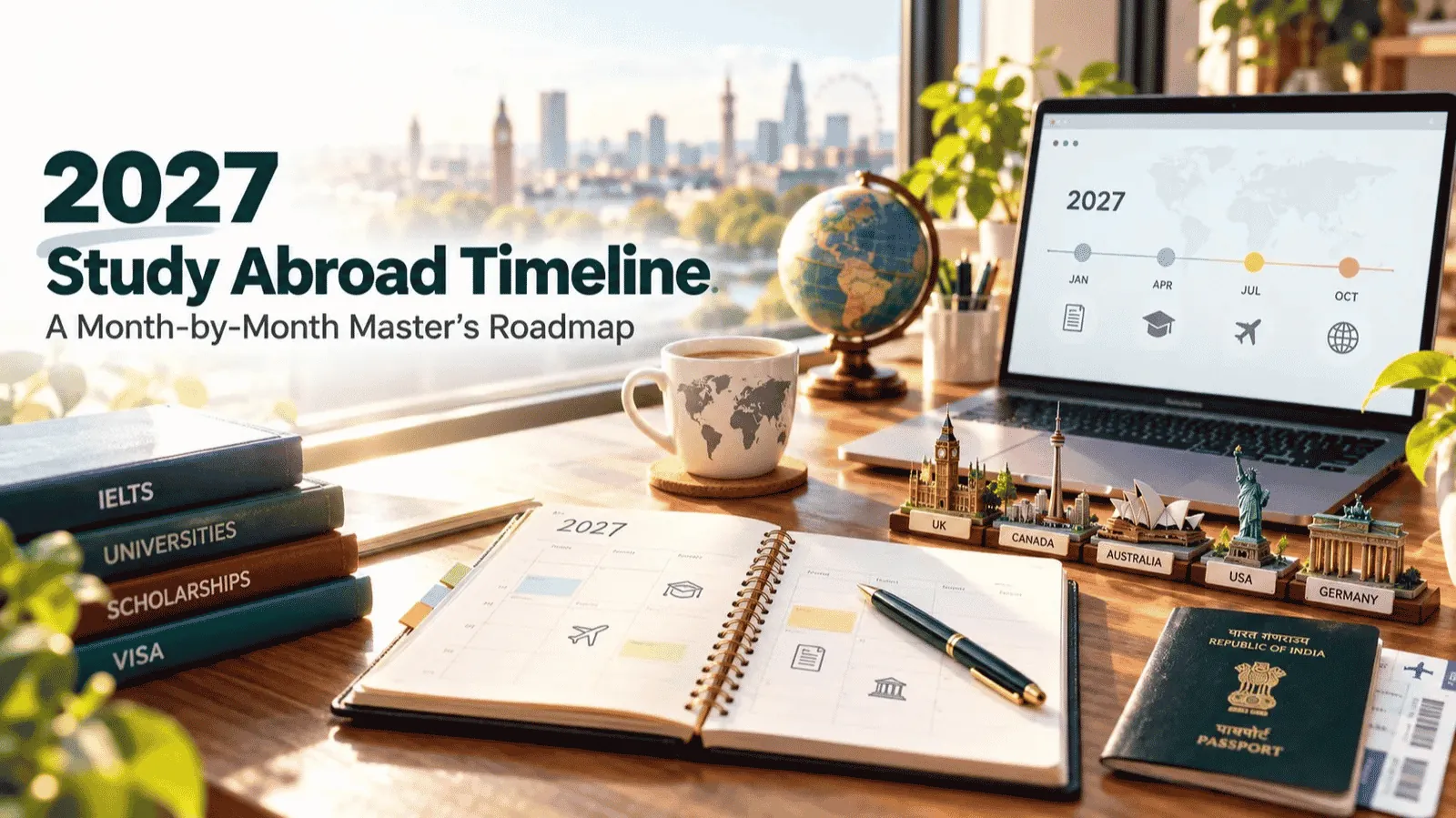
The same foreign degree now costs your family more rupees than it did a year ago. In May 2026 the rupee hit a record low of about 96.97 per US dollar (Multibagg, 2026). This guide takes each country's official living-cost rule and converts it into rupees. It then shares practical tips for study abroad budgets, so your family can plan a 2027 intake from real numbers instead of guesses.
At a glance
Two forces are pushing costs up together. The rupee has weakened against the US dollar, so every dollar fee needs more rupees. Visa rules have also moved, with Canada asking students to show more money for living costs. A family planning a 2027 intake has to handle both pressures at once, which is why older budgets no longer hold.
On the currency side, the rupee touched 96.9650 per dollar in May 2026 and traded at 94.97 on 2 November 2026 (Multibagg, 2026). The same report links the fall to Brent crude above $100 a barrel, about $20.6 billion of foreign outflows from Indian shares by early May, and a strong US dollar. Students cannot control any of these factors, but they can plan around them.
On the visa side, Canada raised its living-expense figure for a single student outside Quebec from CAN$22,895 to CAN$23,448 for applications made on or after 1 September 2026 (IRCC, 2026). The UK sets separate monthly amounts for London and the rest of the country (GOV.UK, 2026).
The figures below are the minimum living costs each government asks students to show for a visa, converted at ECB rates from 13 November 2026. Tuition, flights, insurance and visa fees come on top. Your bank's rate on the day you pay will differ slightly, so treat these numbers as a floor, not a full budget.
A London student must show £1,529 a month, about ₹1.91 lakh, or roughly ₹17.2 lakh over the nine months the visa covers. Outside London the figure is £1,171 a month, about ₹1.46 lakh, or roughly ₹13.1 lakh for nine months (GOV.UK, 2026; conversion via ECB, 2026). Any unpaid first-year tuition must be shown as well.
One of the most practical tips for studying abroad in London is to price the same course outside the capital. The gap between the two UK rates is £358 a month, roughly ₹44,600 at November 2026 rates (GOV.UK, 2026). If your subject is taught well in Manchester, Leeds or Glasgow, the location alone reshapes your budget.
A single student outside Quebec needs CAN$23,448 for first-year living expenses, about ₹15.5 lakh, and that amount excludes tuition and transport (IRCC, 2026). IRCC accepts several kinds of proof, including a guaranteed investment certificate (GIC, a deposit held with a Canadian bank), an education loan, scholarship letters and six months of bank statements.
Canada's living-cost requirement for a single student outside Quebec rose to CAN$23,448 for study permit applications made on or after 1 September 2026 (IRCC, 2026).
A single student visa (subclass 500) applicant must show AUD 29,710 for 12 months of living costs, about ₹19 lakh, plus first-year course fees and travel (One Planet Migration Law, 2026). The Department of Home Affairs lists the same AUD 29,710 figure on its subclass 500 page (Department of Home Affairs, 2026). Amounts can change, so check that page again before you lodge your application.
If you plan to study in Germany, a blocked account (Sperrkonto, a bank account you cannot fully withdraw from at once) is the usual proof of funds. The 2026 amount is €11,904 a year, or €992 a month, about ₹12.4 lakh a year (Expatrio, 2026). Many public universities charge low or no tuition, which is why Germany often appears at the lower end of the cost range.
The USA has no single national living-cost figure for student visas. Each university lists its own estimated cost of attendance on the I-20, the form you need for an F-1 visa interview, and you must prove you can cover it. For anyone looking to study in the USA, the I-20 estimate from each shortlisted university is the number to convert into rupees.
Here is an example to show the study in USA cost in rupees. It is not a national minimum. Colorado State University estimates $57,357 for a standard graduate program in 2026-27. That covers $34,857 for tuition and fees, $17,442 for living expenses and $5,058 for other costs, over about nine months (Colorado State University, 2026).
At ₹94.24 per dollar, the total is about ₹54.1 lakh for the year. The living-cost part alone is about ₹16.4 lakh, or roughly ₹1.83 lakh a month.

Based on official visa minimums, the study abroad cost per month for Indian students ranges from about ₹1.03 lakh in Germany to about ₹1.91 lakh in London, before tuition. Canada works out to roughly ₹1.29 lakh and Australia to roughly ₹1.58 lakh a month at November 2026 exchange rates (ECB, 2026).
These monthly figures are what governments consider enough to live on, not what every student actually spends. Rent in large cities, shared or private housing and personal habits can push real spending above the minimum. In our counselling work, rent is the cost that most often surprises families, so get real quotes before you finalise a city.
Here is the monthly picture side by side, using the official minimums:
At a glance
A move of even two rupees against the dollar can change a large bill by close to a lakh. Because tuition and living costs are paid in foreign currency, every swing in the exchange rate hits your rupee total directly. That is why the timing of your conversions deserves as much attention as the choice of university.
Here is a concrete example. The rupee traded between its May 2026 low of 96.97 and 94.97 on 2 November 2026 (Multibagg, 2026). On a $40,000 first-year bill, that two-rupee gap adds about ₹80,000.
The same logic applies to the pound, the Canadian and Australian dollar and the euro. A family that converts everything on one bad day carries the full risk of that day's rate. Spreading conversions over several months smooths out the highs and lows.

The most useful tips for study abroad budgets are simple: plan in the foreign currency, test your budget at a weaker rupee, convert in stages and use every scholarship you can. A sound weak rupee study abroad plan spreads currency risk over time instead of betting on one exchange rate. Follow these steps in order.
Most popular study abroad tips focus on culture, travel and making friends, and they often stop at "make a budget." Few of them convert official visa figures into rupees or show what a currency swing does to an Indian family's bill.
General advice still matters. Research your destination, learn local social norms and plan for homesickness. For a 2027 intake, though, money planning should come first, because it decides which countries and cities are realistic for you.
If you are applying for a 2027 intake from Pune, Delhi NCR or anywhere in India, start with the official visa minimums above and add tuition from your shortlisted universities. Then run your total at a weaker rupee rate. If the gap feels too large, compare a lower-cost city, a different country or a stronger scholarship profile before you drop your plans.
Parents funding the degree should agree early on who converts money, when, and through which provider. Students should keep every fee receipt and bank statement, because visa officers ask for clear proof of funds. These tips for study abroad planning work best when the whole family follows one written budget.
If you are still choosing between countries, our page on the best country to study abroad for Indian students weighs cost alongside career prospects and post-study work options.
For the visa, you must show £1,529 a month in London or £1,171 a month elsewhere, for up to nine months, plus any unpaid first-year tuition (GOV.UK, 2026). At November 2026 rates, the London figure is about ₹1.91 lakh a month. Check the rules again before you apply, as they can change.
Among the countries in this guide, Germany has the lowest official living-cost requirement at €11,904 a year, about ₹12.4 lakh (Expatrio, 2026). Many German public universities also charge little or no tuition. Your real cost still depends on the city and your lifestyle.
Usually not. Converting in stages spreads the risk of a bad exchange rate across several dates instead of one. Pay each fee when it falls due and compare provider margins each time.
It can. Canada accepts scholarship proof as part of your funds, though a tuition-only award still leaves you showing money for living and transport (IRCC, 2026). Rules differ by country, so confirm with your counsellor.
Ready to turn these numbers into a plan? Book a session with StudySmart's study abroad counselling team in Pune or Delhi for a country, course and budget plan built around your profile.














































-1750416362-1750417414.jpg)






 (6)-1792571238.png)





-1789647708.png)
-1789648196.png)
 (1)-1787123243.png)















-1749620108.png)















-1791613809.jpg)

-1790399182.png)




-1790830806.png)
-1789648364.png)
-1789648032.png)
-1789647864.png)

-1789648649.png)




-1790228836.png)