-1751978393.webp)

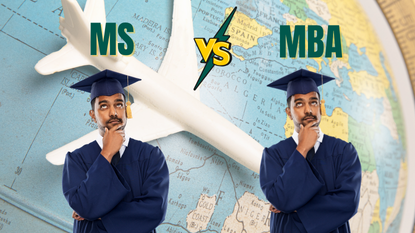
Choosing between an MBA and an MS abroad is one of the first big decisions after graduation, and the wrong choice can cost lakhs of rupees and years of your career. Here is the short answer to the MBA vs MS abroad question. An MS builds deep technical skill and suits fresh graduates. An MBA builds leadership and business skill and usually pays off best after a few years of work.
This guide compares eligibility, entrance tests, career outcomes and post-study work rights in the US and UK, so you and your parents can decide using facts, not guesswork.
At a glance
An MS abroad is a specialist degree that goes deep into one subject, such as computer science, data analytics, engineering or finance. An MBA abroad is a general management degree that teaches strategy, leadership, marketing, operations and finance together. The MS makes you an expert in one field, while the MBA prepares you to lead people and make business decisions.
The classroom also feels different. MS classes are often filled with recent graduates who share a similar academic background, and the work is built around labs, projects and research. MBA classes bring together professionals from many industries, and much of the learning comes from case discussions where students share what they have seen at work.
The career paths differ too. An MS graduate usually enters the job market as a specialist, such as a data scientist, software engineer or quantitative analyst. An MBA graduate often aims for roles that cut across functions, such as consultant, product manager or business head.
For most Indian students coming straight out of a bachelor's degree, an MS is the more practical choice. Universities routinely admit fresh graduates to MS programmes, and the degree gives you job-ready technical skills. A top MBA usually rewards you more once you have work experience to bring into class and to show recruiters.
Think about where you are today. For a B.Tech graduate in computer science from Pune or Delhi who loves coding, an MS abroad after engineering is usually the natural next step. An MS in computer science, artificial intelligence or data science lets that student enter the global job market with in-demand skills and an early start abroad.
A commerce or BBA graduate with no work experience has another option worth knowing: the Master's in Management, often called a MiM. A MiM is a business master's designed for students with little or no work experience. US employers projected median pay for master's in management graduates to rise from $80,000 to $90,000 in GMAC's 2025 Corporate Recruiters Survey (BestColleges, 2025).
If you already have three or four years in a job and want to move from a technical role into leadership, the MBA becomes a much stronger option. That is when the degree's network and management training add the most value.

Yes, some universities do offer an MBA abroad without work experience, but the most competitive full-time programmes generally expect several years in a job. For fresh graduates who want a business career, a Master's in Management abroad is often the better fit, because it is built for early-career students. Always check each programme's admissions page for exact rules.
Here is how experience typically affects each path:
An SOP is the personal essay that explains your goals and why a programme suits you. For MBA applications, the SOP and essays carry extra weight because they show the admissions team how you think about your career.
Most MS programmes in the US ask for the GRE, while MBA programmes usually accept the GMAT or the GRE. Both degrees also need an English test such as IELTS, PTE or TOEFL for Indian applicants. Many UK and European programmes waive the GRE or GMAT but still ask for English scores.
The GRE (Graduate Record Examination) tests verbal reasoning, quantitative reasoning and analytical writing. The GMAT (Graduate Management Admission Test) is designed for business schools and focuses on data insights, quantitative and verbal reasoning. Test requirements change often, so confirm them on each university website before you book.
The English test is not just a formality. A strong IELTS band score widens your list of universities and can support scholarship applications. If you are still preparing, our IELTS, PTE and TOEFL test preparation classes in Pune and Delhi can help you plan the right test for your target universities.

Neither degree always pays off better. The return on an MBA or MS for Indian students depends on the total cost, the country, the field and how long you can work after graduating. An MS from a STEM field often wins on cost and work rights, while a top MBA can pay more for experienced candidates.
Employer expectations give a useful starting point. In GMAC's 2025 survey, US employers projected MBA median pay of $125,000, up from $120,000 in 2024 (BestColleges, 2025). These figures are employer projections, not guaranteed salaries, and MBA graduates usually start from a higher base because they already have work experience.
Cost matters just as much as salary. An MBA often means giving up a salary for one or two years, while an MS taken straight after college has a lower opportunity cost. Opportunity cost means the income you give up while you study. Families should also weigh tuition, living costs and loan interest together. Our education loan assistance for study abroad team can help you compare lenders before you commit.
Post-study work rights decide how long you can earn abroad and repay your loan, so they can shift the whole decision. In the US, a STEM degree can give far more work time than a non-STEM one. In the UK, the date you apply for the Graduate visa now decides how long you can stay.
In the US, Optional Practical Training (OPT) is temporary work permission for F-1 students. F-1 students can get up to 12 months of OPT (USCIS, 2025). Graduates of eligible STEM degrees can apply for a 24-month extension, giving up to 36 months in total (USCIS, 2025). Many MS programmes are STEM-designated, and some US business schools now offer STEM-designated MBAs, so check the designation of every programme you shortlist.
The UK has changed its rules.
UK Graduate visas last 2 years for applications made on or before 31 December 2026, and 18 months for applications made on or after 1 January 2027 (GOV.UK, 2026).
This matters for anyone planning a one-year UK master's that starts in late 2026 or later. Because you can only apply after your university confirms you have finished, most of these students will fall under the new UK Graduate Route of 18 months. Plan your job search for a shorter window, whether you choose an MBA or an MS.
The best way to choose is to start with the job you want five years from now and work backwards. If that job needs deep technical skill, pick an MS. If it needs people leadership and business judgement, and you have some work experience, pick an MBA.
Follow these steps:
If you are a fresh B.Tech or B.Sc graduate, an MS is usually the stronger first step. You gain specialist skills early, you may qualify for longer STEM work rights in the US, and you keep the option of an MBA later once you have experience.
If you are a BBA or B.Com graduate who wants a business career now, look closely at a MiM in the UK or Europe instead of waiting years for an MBA. If you have three or more years of work and want to switch into leadership, consulting or a new industry, an MBA is worth serious thought.
For parents, the key question in the MBA vs MS abroad debate is not which degree sounds bigger. Ask how long your child can work abroad after the course, what the loan repayment looks like, and whether the degree matches a clear career plan. StudySmart counsellors are trained with the British Council, Education New Zealand and Education Ireland, and certified for student counselling by NBCC, UK, so families in Pune, Delhi and beyond get informed, unbiased advice.
For most fresh engineering graduates, an MS is the better first step because it builds on your technical degree and does not require work experience. An MBA makes more sense after a few years in industry, when you want to move into management. Many engineers do an MS first and an MBA later.
Some universities accept fresh graduates into MBA programmes, but the most respected full-time MBAs usually expect several years of work. A Master's in Management is designed for students with little or no experience and is often a smarter choice. You can apply for an MBA later once your career has grown.
Yes. The 18-month limit applies to bachelor's and master's graduates who apply on or after 1 January 2027, whatever their subject. PhD graduates still get 3 years under the GOV.UK rules.
Most US MS programmes ask for the GRE, and most MBA programmes accept the GMAT or GRE. Many UK and European programmes waive these tests but still need an English score such as IELTS. Always confirm requirements on each university's admissions page.
Still unsure which degree fits your profile? Book expert study abroad counselling with StudySmart and get a personalised MBA or MS plan, from test preparation and university shortlisting to SOP writing and visa support.




















































-1750416362-1750417414.jpg)






 (6)-1792571238.png)





-1789647708.png)
-1789648196.png)
 (1)-1787123243.png)


















-1749620108.png)
















-1791613809.jpg)

-1790399182.png)




-1790830806.png)
-1789648364.png)
-1789648032.png)
-1789647864.png)

-1789648649.png)



-1790228836.png)